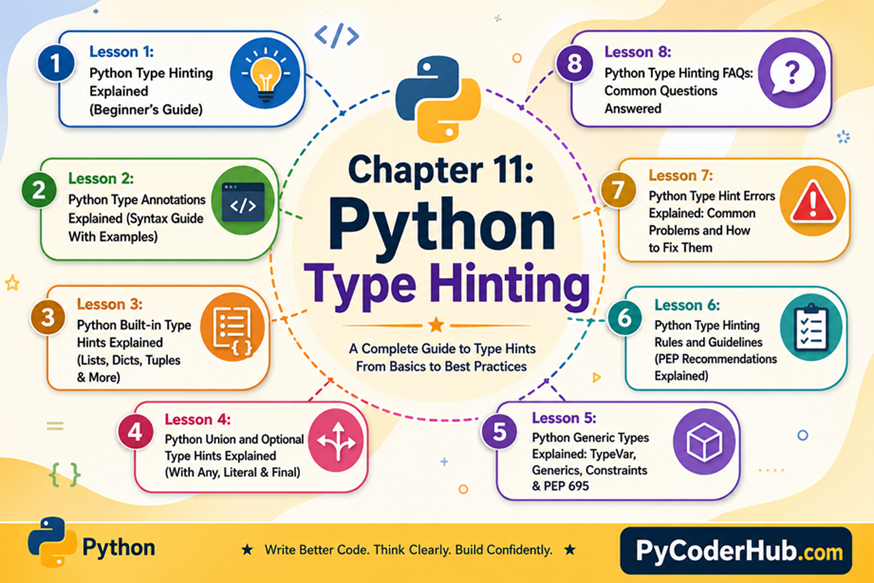
Chapter Overview: Python Type Hinting
In this chapter, you’ll learn the fundamentals of Python type hinting and how type hints make code easier to read, understand, maintain, and debug. You’ll explore what type hinting is, why it was introduced, and how Python’s gradual typing system helps developers write clearer code without changing how Python executes programs.
This chapter covers type annotations, built-in type hints, and commonly used typing features such as Union, Optional, Any, Literal, and Final. You’ll also learn the basics of generic types, including TypeVar, Generics, type constraints, and the modern syntax introduced by PEP 695.
Beyond syntax, you’ll explore important type hinting rules, guidelines, and best practices recommended by the Python typing ecosystem. The chapter also explains common type hint errors, why they occur, and how to fix them effectively.
Along with practical examples and a comprehensive FAQ section, you’ll build a solid understanding of Python type hinting and learn how to use annotations confidently in real-world Python code. By the end of this chapter, you’ll be able to read, write, and understand typed Python code while preparing for more advanced typing concepts in the future.
Note: Python type hinting is a large and evolving topic. This chapter covers the most important concepts needed to understand and use type hints effectively in real-world code. More advanced typing features and specialized use cases can be explored after building a strong foundation with the concepts covered here.
What You Will Learn in This Chapter
In this chapter, you will learn:
- What Python type hinting is and why it was introduced
- How type annotations work for variables, function parameters, and return values
- How to use built-in type hints such as
int,str,list,tuple,dict, andset - How to work with
Union,Optional,Any,Literal, andFinal - The fundamentals of generic types, including
TypeVarand Generics - The basics of modern generic syntax introduced by PEP 695
- Important type hinting rules and recommended best practices
- How static type checking differs from Python’s runtime behavior
- Common type hinting mistakes and how to fix them
- How to interpret and resolve common type-checking errors
- Practical guidelines for writing clear, maintainable type annotations
- Answers to frequently asked questions about Python type hinting
Lessons in This Chapter
Below is a list of all the lessons included in this chapter. Click on any topic to dive into the full tutorial.
Note for Beginners: Many examples throughout these lessons use functions and classes because type hints are commonly applied to them in real-world Python code. If you have not yet learned functions or classes, don’t worry about understanding every detail of how they work. For now, focus on the type hinting concepts being demonstrated and observe where the annotations are placed. Once you study functions and classes in later chapters, these examples will become much easier to understand, and you’ll be able to revisit them with greater confidence.
Lesson 1: Python Type Hinting Explained (Beginner’s Guide)
This lesson introduces the fundamentals of Python type hinting and explains why type hints were added to the language. You’ll learn how type hinting improves code readability, maintenance, and developer productivity while still preserving Python’s dynamic nature. By the end of this lesson, you’ll understand the basic purpose of type hints, how they differ from data types, and where they fit into modern Python development.
What You’ll Learn:
- Why Type Hinting Exists
- What Is Python Type Hinting?
- The Most Important Truth About Type Hints
- Dynamic Typing vs Static Typing vs Gradual Typing
- Why Type Hinting Became Important in Modern Python
- A Brief History of Python Type Hinting (PEP 484 & Beyond)
- Type Hinting vs Type Casting (Very Important)
- What Type Hints Do NOT Do
Lesson 2: Python Type Annotations Explained (Syntax Guide With Examples)
After learning what type hinting is, the next step is understanding how type annotations are written in Python code. In this lesson, you’ll explore the syntax used to annotate variables, function parameters, return values, and other common constructs. Through practical examples, you’ll learn how Python annotations are structured and how to read and write them correctly in real-world programs.
What You’ll Learn:
- Understanding Python Annotation Syntax
- Variable Annotations Explained
- Where Python Stores Annotations
- Variable Annotation Storage in Python
- How Python Organizes Annotation Storage
- Function Parameter Annotations
- Return Type Annotations (->)
- Functions That Return Nothing — -> None
- Class Attribute Annotations
- Type Comments (Legacy Syntax)
Lesson 3: Python Built-in Type Hints Explained (Lists, Dicts, Tuples & More)
Once you understand annotation syntax, it’s time to learn the type hints you’ll use most often in everyday Python code. In this lesson, you’ll explore built-in type hints for common data types such as strings, numbers, lists, tuples, dictionaries, sets, and more. You’ll learn how these annotations describe the structure and contents of data, making your code clearer and easier to understand.
What You’ll Learn:
- What Are Built-in Type Hints?
- Simple / Primitive Built-in Types
- The Special Role of None
- Collection Type Hints
- Homogeneous vs Heterogeneous Collections
- Nested Collection Type Hints
- The Any Type Hint
Lesson 4: Python Union and Optional Type Hints Explained (With Any, Literal & Final)
As programs become more complex, a single type is not always enough to describe every valid value. In this lesson, you’ll learn how to create more flexible type annotations using Union and Optional, along with useful typing tools such as Any, Literal, and Final. These features allow you to express multiple possibilities, fixed values, and special typing scenarios while keeping your code clear and maintainable.
What You’ll Learn:
- Why We Need Flexible Type Hints
- Union Types (Multiple Possible Types)
- Optional Type Hint (The Biggest Confusion)
- Any (The Escape Hatch)
- Literal Types (Exact Allowed Values)
- Final & ClassVar
- Type Aliases (Cleaner Type Hints)
Lesson 5: Python Generic Types Explained: TypeVar, Generics, Constraints & PEP 695
After learning the most commonly used type hints, the next step is understanding how to create reusable and flexible type annotations. In this lesson, you’ll explore generic types, including TypeVar, Generics, type constraints, and the modern syntax introduced by PEP 695. These concepts help you write type-safe code that can work with multiple data types without sacrificing clarity or consistency.
What You’ll Learn:
- The Problem Generics Solve
- Understanding Generic Types
- Understanding TypeVar
- Generic Functions
- Generic Classes
- Constraints and Bounds
- Understanding AnyStr
- PEP 695 Modern Generic Syntax (Python 3.12+)
Lesson 6: Python Type Hinting Rules and Guidelines (PEP Recommendations Explained)
Knowing the syntax of type hints is only part of the learning process. In this lesson, you’ll explore the important rules, guidelines, and recommendations that help developers use type hints effectively in real-world projects. You’ll learn when type hints should be used, how to write them consistently, and which practices improve code readability, maintainability, and long-term code quality.
What You’ll Learn:
- Fundamental Type Hinting Rules
- Annotation Syntax Rules
- Collection Type Hint Rules
- Union, Optional, Any, Literal, and Final Rules
- TypeVar and Generic Type Rules
- Forward Reference Rules
- Modern Type Hinting Guidelines
- Readability and Consistency Guidelines
Lesson 7: Python Type Hint Errors Explained: Common Problems and How to Fix Them
Even when you understand type hint syntax and best practices, mistakes can still occur. In this lesson, you’ll explore some of the most common type hinting errors, why type-checking tools report them, and how to fix them correctly. By understanding these issues, you’ll be better prepared to write accurate annotations and troubleshoot typing-related problems with confidence.
What You’ll Learn:
- Understanding Type Hint Errors
- Basic Annotation Errors
- Collection Type Hint Errors
- Union, Optional, Any, Literal, and Final Errors
- Generic Type Errors
- Readability and Maintainability Mistakes
Lesson 8: Python Type Hinting FAQs: Common Questions Answered
As you learn and apply type hints, it’s natural to encounter questions that don’t fit neatly into a single lesson. This FAQ guide brings together many of the most common questions, confusion points, and practical concerns related to Python type hinting. It serves as a useful recap of the chapter while helping you strengthen your understanding of the concepts covered throughout the lessons.
What You’ll Learn:
- General Python Type Hinting Questions
- Type Annotation Questions
- Built-in Type Hints and Collections Questions
- Union, Optional, Any, Literal, and Final Questions
- Generic Types and TypeVar Questions
- Modern Type Hinting and PEP Questions
- Type Checking and Error Questions
- Best Practices and Real-World Usage Questions
What’s Next After This Chapter
Now that you’ve learned the fundamentals of Python type hinting and how annotations can make code clearer, more maintainable, and easier to understand, it’s time to move deeper into the building blocks of Python expressions and logic.
In the next chapter, you’ll explore Python operators — the symbols and keywords that allow programs to perform calculations, compare values, combine conditions, and manipulate data. You’ll learn how different categories of operators work, including arithmetic, comparison, logical, assignment, membership, identity, and bitwise operators.
If this chapter helped you understand how Python describes and documents data, the next chapter will show you how Python works with that data to perform operations, make decisions, and build more powerful programs.