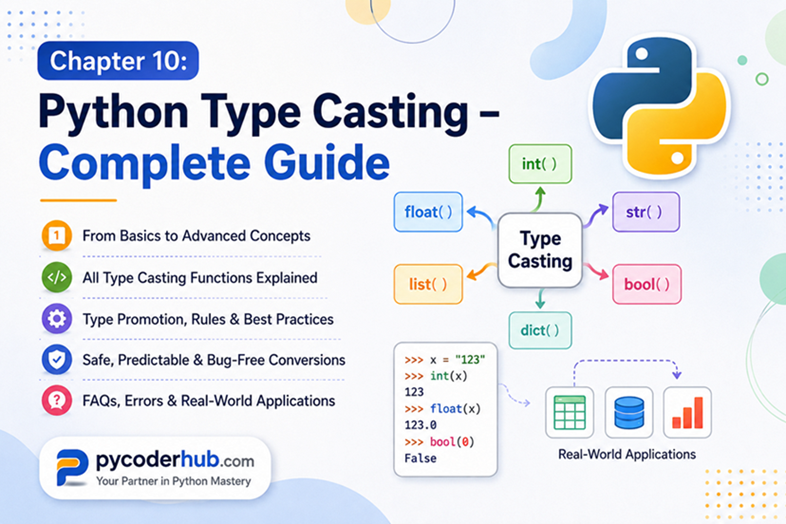
Chapter Overview: Python Type Casting
In this chapter, you’ll learn everything about Python type casting and how Python converts data from one type to another. You’ll understand what type casting is, why it is important, and how Python handles different kinds of conversions internally.
This chapter covers both implicit and explicit type casting, including automatic type promotion and manual conversion using built-in functions like int(), float(), str(), bool(), list(), tuple(), set(), and dict().
You’ll explore how conversions work with numeric values, strings, collections, boolean values, and user input. The chapter also explains concepts like truthy vs falsy values, precision loss, mutable vs immutable conversions, and common conversion errors that can confuse beginners.
Along with practical examples and real-world scenarios, you’ll learn best practices for safe and efficient type conversion in Python programs.
By the end of this chapter, you’ll have a strong understanding of Python type casting, allowing you to confidently convert and manage data across different Python data types in real-world applications.
What You Will Learn in This Chapter
In this chapter, you will learn:
- What Python type casting is and why it is important
- Difference between implicit and explicit type casting
- How Python automatically converts data types internally
- How to manually convert data using built-in type casting functions
- Working with
int(),float(),complex(),str(), andbool() - Converting data into lists, tuples, sets, and dictionaries
- Understanding Python type promotion rules
- Truthy vs falsy values in Python
- Type casting with user input and real-world data
- Precision loss and data conversion limitations
- Mutable vs immutable conversion behavior
- Best practices for safe and efficient type conversion
- Real-world examples of type casting in Python programs
Lessons in This Chapter
Below is a list of all the lessons included in this chapter. Click on any topic to dive into the full tutorial.
Lesson 1: Python Type Casting Explained (Type Conversion for Beginners)
This lesson introduces Python type casting in a simple and beginner-friendly way, explaining what type conversion is and why it is important in programming. It covers how Python converts data from one type to another, both automatically and manually. You’ll also see basic examples to understand how type casting works in real Python programs.
What You’ll Learn:
- What is Type Casting in Python? (Core Explanation)
- Why Python Needs Type Conversion
- Types of Type Casting in Python
- Implicit Type Casting — When Python Handles It for You
- Explicit Type Casting — When You Control the Conversion
- Explicit vs Implicit Casting
- When You Should NOT Use Type Casting
Lesson 2: Python Type Casting Functions Explained (int, float, complex, bool, str)
This lesson explains Python’s most commonly used type casting functions in a simple and beginner-friendly way. You’ll learn how functions like int(), float(), complex(), bool(), and str() convert data from one type to another and how they behave with different kinds of values. You’ll also explore practical examples and common conversion scenarios used in real Python programs.
What You’ll Learn:
- int() Function — Complete Deep Dive
- float() Function — Complete Deep Dive
- complex() Function — Complete Deep Dive
- bool() Function — Complete Deep Dive
- str() Function — Complete Deep Dive
- Conversion Relationship & Confusion Breaker
Lesson 3: Advanced Python Type Casting Functions Explained (list, tuple, set, dict & More)
This lesson explains advanced Python type casting functions used for converting data into collections and other complex data types. You’ll learn how functions like list(), tuple(), set(), dict(), and others work with different kinds of data. You’ll also explore practical examples to understand how these conversions are used in real Python programs.
What You’ll Learn:
- list() — Convert Data into a List
- tuple() — Convert to an Immutable Sequence
- set() — Convert to a Unique Collection
- dict() — Convert to Key-Value Structure
- bin(), oct(), hex() — Number Base Conversions
- bytes(), bytearray(), memoryview() — Byte-Level Type Casting
- ord() & chr() — Character ↔ Number Conversion
- frozenset() — Immutable Set
- repr() — Internal Representation
- ascii() — Safe ASCII Representation
Lesson 4: Python Type Promotion Explained (Implicit Type Conversion & Type Hierarchy)
This lesson explains how Python automatically converts data types during operations using implicit type conversion, also known as type promotion. You’ll learn how Python follows a type hierarchy when different data types interact and why some values are automatically promoted to more complex types. You’ll also explore practical examples to understand how type promotion works in real Python programs.
What You’ll Learn:
- What Is Python Type Promotion?
- Python’s Numeric Tower (Type Hierarchy)
- Widening vs Narrowing (The Real Confusion Breaker)
- Where Python Type Promotion Breaks Down
- When You Must Step In With Explicit Casting
Lesson 5: Python Type Casting Rules – Complete Guide to Safe and Predictable Conversions
This lesson explains the important rules Python follows during type casting and data conversion. You’ll learn which conversions are allowed, which can cause errors, and how Python handles different conversion situations internally. You’ll also explore practical examples and common mistakes to understand how to perform safe and predictable type conversions in real Python programs.
What You’ll Learn:
- Rule 1: Always Know The Source Data Type Before Casting
- Rule 2: Not All Type Conversions Are Allowed
- Rule 3: Type Casting May Lead To Data Loss
- Rule 4: Boolean Conversion Follows Truthiness Rules
- Rule 5: String Conversion Must Match a Valid Format
- Rule 6: Collection Conversions Follow Structural Requirements
- Rule 7: Type Casting Creates a New Object, it Does Not Modify The Original
- Rule 8: Numeric Casting Truncates, It Does Not Round
- Rule 9: Casting is Not The Same as Parsing
- Rule 10: Implicit Conversion Happens Only in Numeric Operations
Lesson 6: Python Type Casting in Real-World Applications: Truthiness, Data Conversion & Safe Casting
This lesson explores how Python type casting is used in real-world programming scenarios. You’ll learn about truthy and falsy values, safe data conversion techniques, and how type casting is used while handling user input, validation, calculations, and data processing. You’ll also see practical examples to understand how proper type conversion helps create reliable Python programs.
What You’ll Learn:
- Boolean Truthiness — Python’s Hidden Conversion System
- Why Truthiness Matters in Real Code
- Lossy vs Lossless Conversion — When Data Disappears
- Type Casting with User Input
- Type Casting with File Data (CSV & Text)
- Type Casting with API & JSON Data
- Edge Case Conversions — The Weird & Dangerous Ones
Lesson 7: Python Type Casting Best Practices – Write Safe, Predictable & Bug-Free Code
This lesson explains the best practices developers should follow while performing type casting in Python. You’ll learn how to write safe, predictable, and clean conversion logic while avoiding common bugs and unexpected behavior. The lesson also covers practical techniques for validation, error handling, readable code, and efficient type conversion in real Python programs.
What You’ll Learn:
- Best Practice #1: Validate Before Casting
- Best Practice #2: Always Be Explicit with Type Conversion
- Best Practice #3: Handle Conversion Errors Gracefully
- Best Practice #4: Avoid Unnecessary Type Casting
- Best Practice #5: Preserve Data Precision During Conversion
- Best Practice #6: Keep Type Casting Close to the Data Source
- Best Practice #7: Choose the Right Data Type for the Context
- Best Practice #8: Be Careful with Boolean Type Casting
- Best Practice #9: Handle None and Empty Values Explicitly
- Best Practice #10: Write Readable and Maintainable Conversion Logic
Lesson 8: Python Type Casting FAQs: Common Conversion Questions, Errors & Confusions Explained
This lesson answers common questions and confusion related to Python type casting and data conversion. You’ll learn why certain conversions work, why some fail with errors, and how Python behaves in tricky conversion situations. The lesson also covers beginner mistakes, unexpected results, and practical explanations to help you understand Python type casting more clearly.
What You’ll Learn:
- Basic Python Type Casting FAQs
- Conversion Function FAQs (int(), float(), bool(), str())
- Advanced Conversion FAQs (list(), tuple(), set(), dict() & More)
- Type Promotion & Implicit Conversion FAQs
- Truthiness & Boolean Conversion FAQs
- Safe Casting & Error Handling FAQs
- Real-World Type Casting FAQs
- Python Type Casting Best Practices FAQs
What’s Next After This Chapter
Now that you’ve understood Python type casting and how data can be converted between different types, it’s time to move one step further into writing clearer and more structured Python code.
In the next chapter, you’ll explore Python type hinting — a feature that allows you to specify the expected data types of variables, function parameters, and return values. You’ll learn how type hints improve code readability, reduce confusion, and help developers write more maintainable programs.
If this chapter helped you understand how Python transforms data, the next chapter will show you how to describe and organize that data more clearly in real-world Python applications.