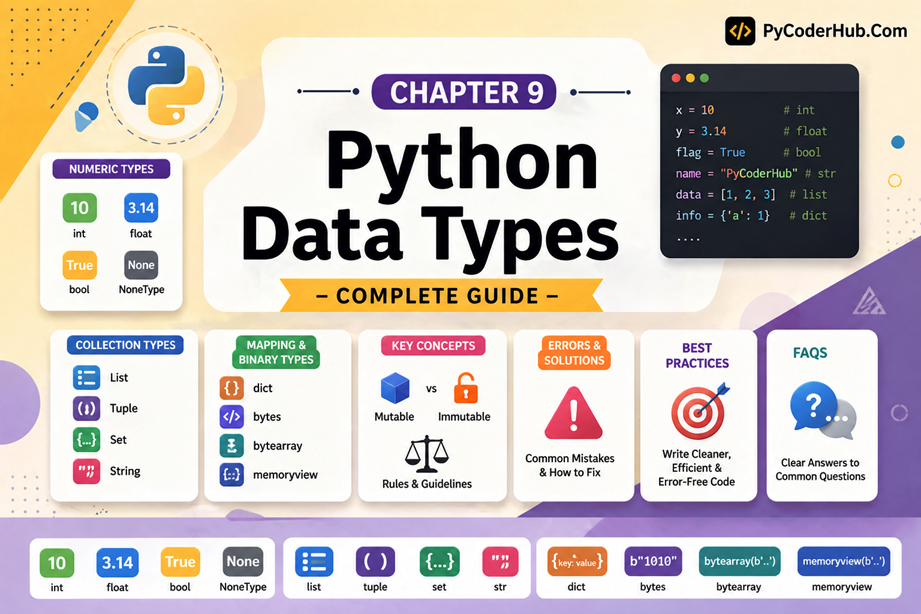
Chapter Overview: Python Data Types
In this chapter, you’ll learn everything about Python data types and how they are used to store, organize, and manage data in Python programs. You’ll understand what data types are, why they are important, and how Python handles different kinds of data internally.
This chapter covers all major Python data types, including numeric types (int, float, complex), sequences like strings, lists, and tuples, as well as sets and dictionaries. You’ll explore concepts like mutability vs immutability, type checking, type conversion, and how different data types behave in real-world scenarios.
You’ll also learn practical examples, best practices for choosing the right data type, and common mistakes that can lead to unexpected results or confusion while working with data.
By the end of this chapter, you’ll have a strong understanding of Python data types, allowing you to write efficient, reliable, and well-structured Python programs.
What You Will Learn in This Chapter
In this chapter, you will learn:
- What Python data types are and why they are essential for storing and managing data
- The different built-in data types such as
int,float,complex,str,list,tuple,set, anddict - How Python classifies data types into categories like numeric, sequence, and collection types
- The concept of mutability vs immutability and how it affects data behavior
- How to check data types using functions like
type()andisinstance() - How different data types behave in real-world scenarios with practical examples
- Common mistakes and confusion when working with data types and how to avoid them
- Best practices for choosing the right data type for clean, efficient, and maintainable Python code
Lessons in This Chapter
Below is a list of all the lessons included in this chapter. Click on any topic to dive into the full tutorial.
Lesson 1: Python Data Types Explained: Beginner-Friendly Introduction
This lesson introduces Python data types in a simple and beginner-friendly way, explaining what they are and why they matter in programming. It covers how Python stores different kinds of data and how to identify them in your code. You’ll also see basic examples to understand how data types are used in real programs.
What You’ll Learn:
- What Is a Data Type in Python?
- Why Do Data Types Matter in Python?
- Understanding Data Types with Real-Life Examples
- Python Is a Dynamically Typed Language
- Data Types vs Variables (Beginner Clarification)
- Everything in Python Is an Object
- How to Check Data Types in Python
- Common Built-in Data Types in Python (Overview)
- Why Data Type Categories Can Feel Confusing
Lesson 2: Python Numeric Data Types Explained (int, float, bool, None)
This lesson introduces Python’s core numeric data types in a simple and beginner-friendly way. You’ll learn about int, float, bool, and None, how they are used, and how Python represents them internally. It also covers basic examples to help you understand their role in real programs and how they behave in different situations.
What You’ll Learn:
- Python Numeric Data Types (int, float, complex)
- Types of Numeric Data in Python
- int vs float vs complex
- Type Conversion Between Numeric Types
- Python Boolean Data Type (True or False)
- Types of Boolean Data Type in Python
- Python None Data Type (NoneType Explained)
- Comparing Numeric, Boolean, and None Data Types
Lesson 3: Python Collection Data Types Explained (List, Tuple, Set, String)
This lesson introduces Python’s collection data types in a simple and beginner-friendly way. You’ll learn about list, tuple, set, and string, how they store multiple values, and how they differ from each other. It also includes basic examples to help you understand how these data types are used in real programs.
What You’ll Learn:
- Python Sequence Data Types
- Types of Sequence Data Types in Python
- list vs tuple vs range
- Python Set Data Types
- Types of Set Data Types
- Type Checking & Type Conversion in Python Set Data Types
- Python Text Data Type (String)
- Comparing Sequence, Set, and Text Data Types
Lesson 4: Python Mapping and Binary Data Types Explained (dict, bytes, bytearray, memoryview)
This lesson introduces Python’s mapping and binary data types in a simple and beginner-friendly way. You’ll learn about dict, bytes, bytearray, and memoryview, how they store and manage data, and where they are used. It also includes basic examples to help you understand their role in real-world programs.
What You’ll Learn:
- Python Mapping Data Type (dict)
- Creating a Dictionary in Python
- Type Checking for Dictionary
- Python Binary Data Types
- Difference Between bytes and bytearray
- Difference Between Mapping and Binary Data Types
Lesson 5: Python Data Types Rules and Guidelines: What You Must Know
This lesson explains the essential rules and guidelines you need to follow when working with Python data types. You’ll learn best practices, common mistakes to avoid, and how to choose the right data type in different situations. It also includes simple examples to help you write cleaner, more efficient, and error-free code.
What You’ll Learn:
- Rule 1: Every Value in Python Has a Data Type
- Rule 2: Python Uses Dynamic Typing
- Rule 3: Some Data Types Are Immutable
- Rule 4: Mutable Data Types Can Be Modified After Creation
- Rule 5: Data Type Compatibility Matters in Operations
Lesson 6: Mutable vs Immutable in Python (Data Types Explained with Examples)
This lesson explains the concept of mutable and immutable data types in a simple and beginner-friendly way. You’ll learn how data can change (or not change) in memory and why this matters in Python programs. It also includes clear examples to help you understand their behavior and avoid common confusion while coding.
What You’ll Learn:
- What Does Mutable and Immutable Mean in Python?
- Why Does This Concept Matter in Python?
- List of Mutable and Immutable Data Types in Python
- Understanding Mutability with Memory Behavior (Using id())
- Mutable Data Types Explained with Examples
- Immutable Data Types Explained with Examples
- Hashability and Why It Matters
- Are Tuples Always Immutable?
Lesson 7: Python Data Types Errors Explained: Common Mistakes and How to Fix Them
This lesson helps you understand the most common errors related to Python data types in a simple and beginner-friendly way. You’ll learn why these mistakes happen, how to identify them, and how to fix them effectively. It also includes practical examples to help you avoid confusion and write more reliable code.
What You’ll Learn:
- Error #1: TypeError – Unsupported Operand Type(s)
- Error #2: TypeError – Cannot Concatenate ‘str’ and ‘int’
- Error #3: TypeError – ‘int’ Object Is Not Subscriptable
- Error #4: TypeError – Unhashable Type: ‘list’
- Error #5: ValueError – Invalid Literal for int()
- Error #6: TypeError – ‘float’ Object Cannot Be Interpreted as an Integer
- Error #7: AttributeError – ‘int’ Object Has No Attribute
Lesson 8: Python Data Types Best Practices: Write Cleaner, Efficient, and Error-Free Code
This lesson covers essential best practices for working with Python data types in a clear and beginner-friendly way. You’ll learn how to choose the right data type, write cleaner code, and avoid common mistakes. It also includes practical tips and examples to help you improve code efficiency and reliability.
What You’ll Learn:
- Best Practice #1 – Use the Right Data Type for the Right Job
- Best Practice #2 – Avoid Unnecessary Type Conversions
- Best Practice #3 – Choose Mutable vs Immutable Data Types Wisely
- Best Practice #4 – Use Built-in Data Types Instead of Custom Logic
- Best Practice #5 – Prefer Lists for Ordered Data, Sets for Unique Data
- Best Practice #6 – Use Dictionary for Fast and Clear Data Access
- Best Practice #7 – Avoid Mixing Data Types Unnecessarily
- Best Practice #8 – Use Meaningful Variable Names Based on Data Type
Lesson 9: Python Data Types FAQs: Clear Answers to Common Questions (Beginner to Advanced)
This lesson answers the most common questions about Python data types in a clear and beginner-friendly way. It covers key doubts, common confusion areas, and practical explanations from basic to advanced concepts. You’ll get quick, easy-to-understand answers to strengthen your understanding and improve your coding confidence.
What You’ll Learn:
- Basic Python Data Types FAQs
- Numeric Data Types FAQs
- Sequence & Collection Data Types FAQs
- Mapping & Binary Data Types FAQs
- Mutable vs Immutable FAQs
- Python Data Types Errors FAQs
- Real-World Usage & Practical FAQs
What’s Next After This Chapter
Now that you’ve understood Python data types and how they store, organize, and manage different kinds of data, it’s time to move one step further into handling data effectively.
In the next chapter, you’ll explore Python type casting — the process of converting data from one type to another. You’ll learn how and when to perform type conversion, how Python handles it automatically, and how to avoid common errors.
If this chapter helped you understand how data is represented in Python, the next chapter will show you how to transform and work with that data more flexibly in real programs.