Skip to content

PyCoderHub

Learn Python Step by Step — From Basics to Advanced

  • Home
  • Python Tutorial
    • Chapter 1: Python Introduction
      • Lesson 1: What is Python?
      • Lesson 2: Python History
      • Lesson 3: Python Programming Terms Explained
      • Lesson 4: Installation of Python and PyCharm IDE
      • Lesson 5: Python IDLE Explained
      • Lesson 6: Python Introduction FAQs
    • Chapter 2: Python Variables
      • Lesson 1: Python Variables Explained
      • Lesson 2: Assigning Multiple Values to Python Variables
      • Lesson 3: Variable Unpacking in Python
      • Lesson 4: Python Variable Naming Rules and Conventions
      • Lesson 5: Dynamic Typing in Python
      • Lesson 6: Strong Typing in Python
      • Lesson 7: Python Variables FAQs
    • Chapter 3: Python Comments
      • Lesson 1: Python Comments Explained
      • Lesson 2: Python Single-Line and Multi-Line Comments Explained
      • Lesson 3: PEP 8 Guidelines for Python Comments
      • Lesson 4: Python Comments FAQ
    • Chapter 4: Python Docstrings
      • Lesson 1: Python Docstrings Explained
      • Lesson 2: Python Docstring Structure and Style Guide
      • Lesson 3: PEP 257 Guidelines for Python Docstrings
      • Lesson 4: Python Docstrings FAQ
    • Chapter 5: Python Quotes
      • Lesson 1: Python Quotes Explained
      • Lesson 2: Python Quotes Rules and Guidelines
      • Lesson 3: Python Quotes Best Practices
      • Lesson 4: Quotes vs Comments vs Docstrings in Python
      • Lesson 5: Python Quotes FAQ
    • Chapter 6: Python Indentation
      • Lesson 1: Python Indentation Explained
      • Lesson 2: Python Indentation Rules and Guidelines
      • Lesson 3: Python Nested Indentation & Block of Code
      • Lesson 4: Python Indentation Common Errors
      • Lesson 5: Python Indentation Best Practices
      • Lesson 6: Python Indentation FAQ
    • Chapter 7: Python Escape Sequences
      • Lesson 1: Python Escape Sequences Explained
      • Lesson 2: Common Python Escape Sequences \n \t \ Explained
      • Lesson 3: Less Common Python Escape Sequences \f \b \r Explained
      • Lesson 4: Python Escape Sequences Rules
      • Lesson 5: Python Escape Sequences Errors
      • Lesson 6: Python Escape Sequences Best Practices
      • Lesson 7: Python Escape Sequences FAQ
    • Chapter 8: Python Keywords
      • Lesson 1: Python Keywords Explained
      • Lesson 2: Python Control Flow, Function and Class Keywords Explained
      • Lesson 3: Python Exception Handling Keywords Explained
      • Lesson 4: Python Scope Keywords Explained
      • Lesson 5: Python Soft Keywords Explained
      • Lesson 6: Python Keyword Rules and Guidelines
      • Lesson 7: Python Keyword Module Explained
      • Lesson 8: Python Keyword Errors Explained
      • Lesson 9: Python Keywords Evolution
      • Lesson 10: Python Keywords Best Practices
      • Lesson 11: Python Keywords FAQ
    • Chapter 9: Python Data Types
      • Lesson 1: Python Data Types Explained
  • Contact Us
Start Your Python Journey

Home » Python None Data Types

Python None Data Types

Python Numeric Data Types Explained (int, float, bool, None)
Posted in
  • Python Basics

Python Numeric Data Types Explained (int, float, bool, None)

Understand Python Numeric Data Types like int, float, bool, and None with simple examples, type checking, comparisons, and beginner-friendly explanations.
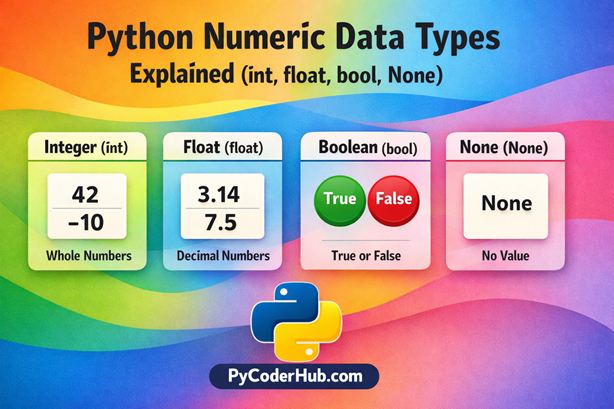
Python Numeric Data Types Explained (int, float, bool, None) Read More
by PyCoder-March 28, 2026March 28, 2026

Categories

  • Python Basics (29)
  • Python Best Practices (4)
  • Python Errors and Fixes (3)
  • Python FAQs (8)
  • Python Modules (1)
  • Python PEP Guidelines (8)
  • Python Practicals (2)
Copyright © 2026 PyCoderHub.
Powered by WordPress and HybridMag.
  • Home
  • Python Tutorial
    • Chapter 1: Python Introduction
      • Lesson 1: What is Python?
      • Lesson 2: Python History
      • Lesson 3: Python Programming Terms Explained
      • Lesson 4: Installation of Python and PyCharm IDE
      • Lesson 5: Python IDLE Explained
      • Lesson 6: Python Introduction FAQs
    • Chapter 2: Python Variables
      • Lesson 1: Python Variables Explained
      • Lesson 2: Assigning Multiple Values to Python Variables
      • Lesson 3: Variable Unpacking in Python
      • Lesson 4: Python Variable Naming Rules and Conventions
      • Lesson 5: Dynamic Typing in Python
      • Lesson 6: Strong Typing in Python
      • Lesson 7: Python Variables FAQs
    • Chapter 3: Python Comments
      • Lesson 1: Python Comments Explained
      • Lesson 2: Python Single-Line and Multi-Line Comments Explained
      • Lesson 3: PEP 8 Guidelines for Python Comments
      • Lesson 4: Python Comments FAQ
    • Chapter 4: Python Docstrings
      • Lesson 1: Python Docstrings Explained
      • Lesson 2: Python Docstring Structure and Style Guide
      • Lesson 3: PEP 257 Guidelines for Python Docstrings
      • Lesson 4: Python Docstrings FAQ
    • Chapter 5: Python Quotes
      • Lesson 1: Python Quotes Explained
      • Lesson 2: Python Quotes Rules and Guidelines
      • Lesson 3: Python Quotes Best Practices
      • Lesson 4: Quotes vs Comments vs Docstrings in Python
      • Lesson 5: Python Quotes FAQ
    • Chapter 6: Python Indentation
      • Lesson 1: Python Indentation Explained
      • Lesson 2: Python Indentation Rules and Guidelines
      • Lesson 3: Python Nested Indentation & Block of Code
      • Lesson 4: Python Indentation Common Errors
      • Lesson 5: Python Indentation Best Practices
      • Lesson 6: Python Indentation FAQ
    • Chapter 7: Python Escape Sequences
      • Lesson 1: Python Escape Sequences Explained
      • Lesson 2: Common Python Escape Sequences \n \t \ Explained
      • Lesson 3: Less Common Python Escape Sequences \f \b \r Explained
      • Lesson 4: Python Escape Sequences Rules
      • Lesson 5: Python Escape Sequences Errors
      • Lesson 6: Python Escape Sequences Best Practices
      • Lesson 7: Python Escape Sequences FAQ
    • Chapter 8: Python Keywords
      • Lesson 1: Python Keywords Explained
      • Lesson 2: Python Control Flow, Function and Class Keywords Explained
      • Lesson 3: Python Exception Handling Keywords Explained
      • Lesson 4: Python Scope Keywords Explained
      • Lesson 5: Python Soft Keywords Explained
      • Lesson 6: Python Keyword Rules and Guidelines
      • Lesson 7: Python Keyword Module Explained
      • Lesson 8: Python Keyword Errors Explained
      • Lesson 9: Python Keywords Evolution
      • Lesson 10: Python Keywords Best Practices
      • Lesson 11: Python Keywords FAQ
    • Chapter 9: Python Data Types
      • Lesson 1: Python Data Types Explained
  • Contact Us