Skip to content

PyCoderHub

Learn Python Step by Step — From Basics to Advanced

  • Home
  • Python Tutorial
    • Chapter 1: Python Introduction
      • Lesson 1: What is Python?
      • Lesson 2: Python History
      • Lesson 3: Python Programming Terms Explained
      • Lesson 4: Installation of Python and PyCharm IDE
      • Lesson 5: Python IDLE Explained
      • Lesson 6: Python Introduction FAQs
    • Chapter 2: Python Variables
      • Lesson 1: Python Variables Explained
      • Lesson 2: Assigning Multiple Values to Python Variables
      • Lesson 3: Variable Unpacking in Python
      • Lesson 4: Python Variable Naming Rules and Conventions
      • Lesson 5: Dynamic Typing in Python
      • Lesson 6: Strong Typing in Python
      • Lesson 7: Python Variables FAQs
    • Chapter 3: Python Comments
      • Lesson 1: Python Comments Explained
      • Lesson 2: Python Single-Line and Multi-Line Comments Explained
      • Lesson 3: PEP 8 Guidelines for Python Comments
      • Lesson 4: Python Comments FAQ
    • Chapter 4: Python Docstrings
      • Lesson 1: Python Docstrings Explained
      • Lesson 2: Python Docstring Structure and Style Guide
      • Lesson 3: PEP 257 Guidelines for Python Docstrings
      • Lesson 4: Python Docstrings FAQ
    • Chapter 5: Python Quotes
      • Lesson 1: Python Quotes Explained
      • Lesson 2: Python Quotes Rules and Guidelines
      • Lesson 3: Python Quotes Best Practices
      • Lesson 4: Quotes vs Comments vs Docstrings in Python
      • Lesson 5: Python Quotes FAQ
    • Chapter 6: Python Indentation
      • Lesson 1: Python Indentation Explained
      • Lesson 2: Python Indentation Rules and Guidelines
      • Lesson 3: Python Nested Indentation & Block of Code
      • Lesson 4: Python Indentation Common Errors
      • Lesson 5: Python Indentation Best Practices
      • Lesson 6: Python Indentation FAQ
    • Chapter 7: Python Escape Sequences
      • Lesson 1: Python Escape Sequences Explained
      • Lesson 2: Common Python Escape Sequences \n \t \ Explained
      • Lesson 3: Less Common Python Escape Sequences \f \b \r Explained
      • Lesson 4: Python Escape Sequences Rules
      • Lesson 5: Python Escape Sequences Errors
      • Lesson 6: Python Escape Sequences Best Practices
      • Lesson 7: Python Escape Sequences FAQ
    • Chapter 8: Python Keywords
      • Lesson 1: Python Keywords Explained
      • Lesson 2: Python Control Flow, Function and Class Keywords Explained
      • Lesson 3: Python Exception Handling Keywords Explained
      • Lesson 4: Python Scope Keywords Explained
      • Lesson 5: Python Soft Keywords Explained
      • Lesson 6: Python Keyword Rules and Guidelines
      • Lesson 7: Python Keyword Module Explained
      • Lesson 8: Python Keyword Errors Explained
      • Lesson 9: Python Keywords Evolution
      • Lesson 10: Python Keywords Best Practices
      • Lesson 11: Python Keywords FAQ
    • Chapter 9: Python Data Types
      • Lesson 1: Python Data Types Explained
  • Contact Us
Start Your Python Journey

Home » Chapter 5

Chapter 5

Python Quotes FAQ: Common Questions and Clear Answers
Posted in
  • Python FAQs

Python Quotes FAQ: Common Questions and Clear Answers

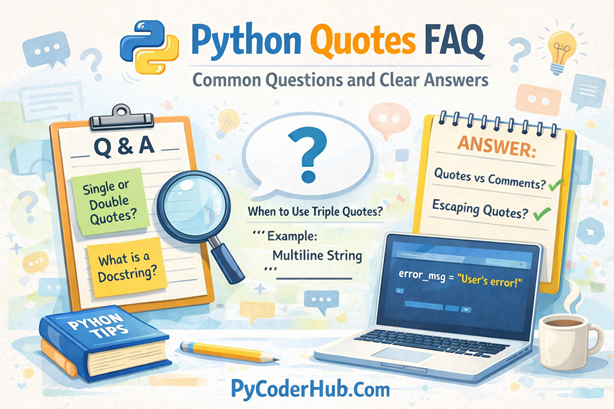
Python Quotes FAQ is a comprehensive question-and-answer guide that clears common confusion around Python quotes. This final chapter answers what developers frequently ask, helping you understand how quotes behave in real code and when to use them confidently.
Python Quotes FAQ: Common Questions and Clear Answers Read More
by PyCoder-February 10, 2026February 21, 2026
Quotes vs Comments vs Docstrings in Python: What’s the Difference and When to Use Each
Posted in
  • Python Basics

Quotes vs Comments vs Docstrings in Python: What’s the Difference and When to Use Each

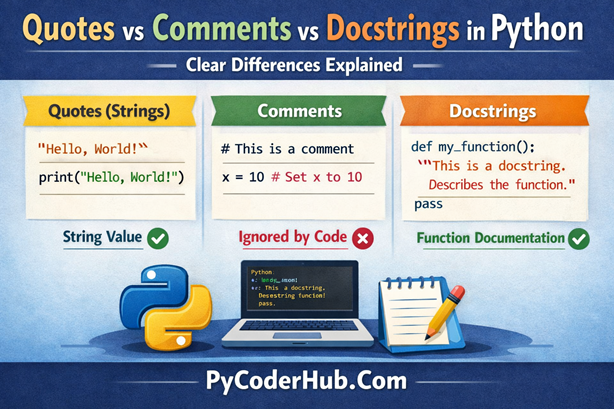
Confused about quotes, comments, and docstrings? This lesson explains Quotes vs Comments vs Docstrings in Python, showing how each works, their real differences, and when to use them correctly in Python code.

Quotes vs Comments vs Docstrings in Python: What’s the Difference and When to Use Each Read More
by PyCoder-February 9, 2026February 21, 2026
Python Quotes: Best Practices, Common Pitfalls, and Tricky Scenarios Explained
Posted in
  • Python Best Practices

Python Quotes: Best Practices, Common Pitfalls, and Tricky Scenarios Explained

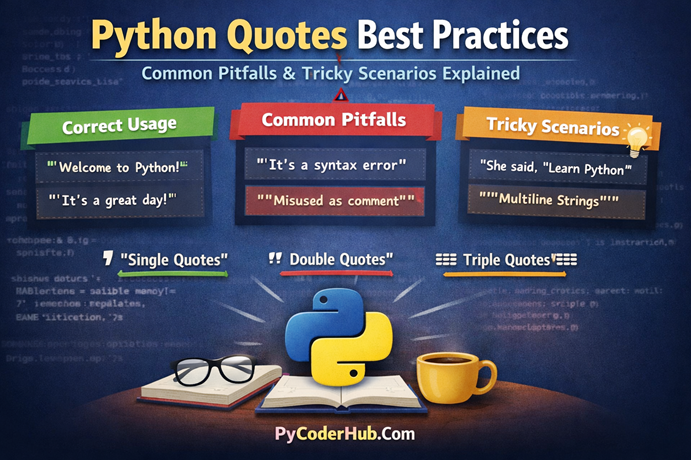
This lesson explores Python quotes best practices with real-world examples, common pitfalls, and tricky scenarios that developers often face. Learn how to choose the right quote type, avoid common mistakes, and write clear, professional Python strings.

Python Quotes: Best Practices, Common Pitfalls, and Tricky Scenarios Explained Read More
by PyCoder-February 8, 2026March 2, 2026
Python Quotes Rules and Guidelines: A Complete Usage Handbook
Posted in
  • Python PEP Guidelines

Python Quotes Rules and Guidelines: A Complete Usage Handbook

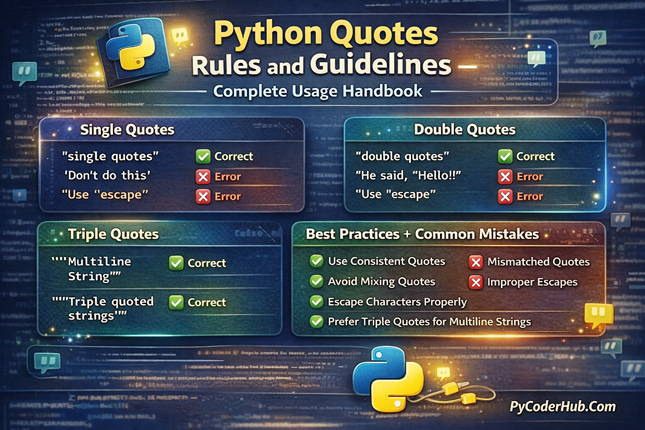
This guide covers Python Quotes Rules and Guidelines in detail, explaining how to use single, double, and triple quotes correctly, avoid common errors, and follow best practices for reliable string handling in Python.

Python Quotes Rules and Guidelines: A Complete Usage Handbook Read More
by PyCoder-February 6, 2026February 21, 2026
Python Quotes Explained – Single, Double, and Triple Quotes with Best Practices
Posted in
  • Python Basics

Python Quotes Explained – Single, Double, and Triple Quotes with Best Practices

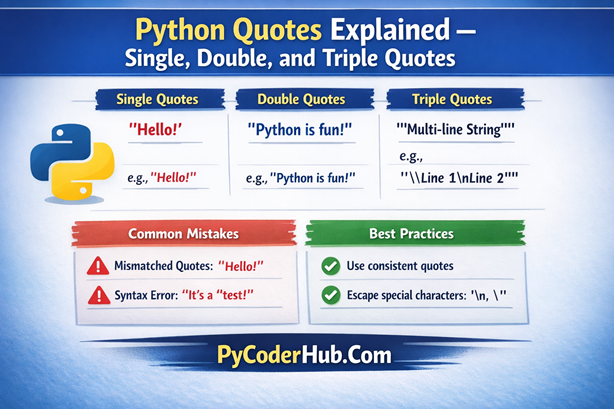
Python Quotes Explained covers how single, double, and triple quotes work in Python, why quotes matter when creating strings, common beginner mistakes, and best practices for writing clear and consistent string literals.

Python Quotes Explained – Single, Double, and Triple Quotes with Best Practices Read More
by PyCoder-February 4, 2026February 21, 2026

Categories

  • Python Basics (29)
  • Python Best Practices (4)
  • Python Errors and Fixes (3)
  • Python FAQs (8)
  • Python Modules (1)
  • Python PEP Guidelines (8)
  • Python Practicals (2)
Copyright © 2026 PyCoderHub.
Powered by WordPress and HybridMag.
  • Home
  • Python Tutorial
    • Chapter 1: Python Introduction
      • Lesson 1: What is Python?
      • Lesson 2: Python History
      • Lesson 3: Python Programming Terms Explained
      • Lesson 4: Installation of Python and PyCharm IDE
      • Lesson 5: Python IDLE Explained
      • Lesson 6: Python Introduction FAQs
    • Chapter 2: Python Variables
      • Lesson 1: Python Variables Explained
      • Lesson 2: Assigning Multiple Values to Python Variables
      • Lesson 3: Variable Unpacking in Python
      • Lesson 4: Python Variable Naming Rules and Conventions
      • Lesson 5: Dynamic Typing in Python
      • Lesson 6: Strong Typing in Python
      • Lesson 7: Python Variables FAQs
    • Chapter 3: Python Comments
      • Lesson 1: Python Comments Explained
      • Lesson 2: Python Single-Line and Multi-Line Comments Explained
      • Lesson 3: PEP 8 Guidelines for Python Comments
      • Lesson 4: Python Comments FAQ
    • Chapter 4: Python Docstrings
      • Lesson 1: Python Docstrings Explained
      • Lesson 2: Python Docstring Structure and Style Guide
      • Lesson 3: PEP 257 Guidelines for Python Docstrings
      • Lesson 4: Python Docstrings FAQ
    • Chapter 5: Python Quotes
      • Lesson 1: Python Quotes Explained
      • Lesson 2: Python Quotes Rules and Guidelines
      • Lesson 3: Python Quotes Best Practices
      • Lesson 4: Quotes vs Comments vs Docstrings in Python
      • Lesson 5: Python Quotes FAQ
    • Chapter 6: Python Indentation
      • Lesson 1: Python Indentation Explained
      • Lesson 2: Python Indentation Rules and Guidelines
      • Lesson 3: Python Nested Indentation & Block of Code
      • Lesson 4: Python Indentation Common Errors
      • Lesson 5: Python Indentation Best Practices
      • Lesson 6: Python Indentation FAQ
    • Chapter 7: Python Escape Sequences
      • Lesson 1: Python Escape Sequences Explained
      • Lesson 2: Common Python Escape Sequences \n \t \ Explained
      • Lesson 3: Less Common Python Escape Sequences \f \b \r Explained
      • Lesson 4: Python Escape Sequences Rules
      • Lesson 5: Python Escape Sequences Errors
      • Lesson 6: Python Escape Sequences Best Practices
      • Lesson 7: Python Escape Sequences FAQ
    • Chapter 8: Python Keywords
      • Lesson 1: Python Keywords Explained
      • Lesson 2: Python Control Flow, Function and Class Keywords Explained
      • Lesson 3: Python Exception Handling Keywords Explained
      • Lesson 4: Python Scope Keywords Explained
      • Lesson 5: Python Soft Keywords Explained
      • Lesson 6: Python Keyword Rules and Guidelines
      • Lesson 7: Python Keyword Module Explained
      • Lesson 8: Python Keyword Errors Explained
      • Lesson 9: Python Keywords Evolution
      • Lesson 10: Python Keywords Best Practices
      • Lesson 11: Python Keywords FAQ
    • Chapter 9: Python Data Types
      • Lesson 1: Python Data Types Explained
  • Contact Us