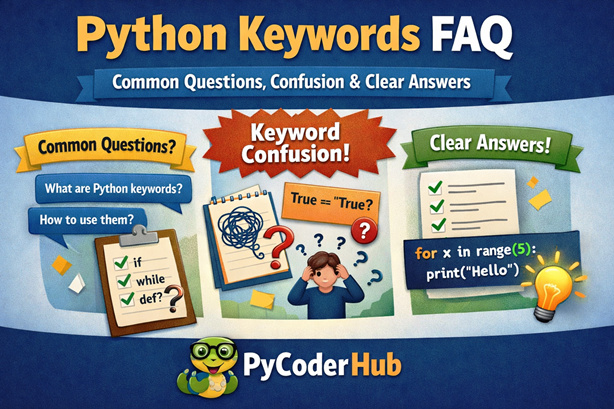
Introduction: Python Keywords FAQ
Now that you’ve completed all the lessons in this chapter—from understanding Python keywords to exploring their rules, types, errors, and best practices—you’ve built a strong foundation.
But when you start writing real code, it’s completely normal to face small doubts, confusion, or “why does this behave like this?” moments.
That’s exactly why this Python Keywords FAQ exists.
This guide brings together everything you’ve learned and answers the most common questions developers ask. Whether you’re revising concepts or clearing confusion, this FAQ will help you gain clarity and confidence.
What You’ll Learn
In this Python Keywords FAQ, you’ll explore:
- Answers to the most common Python keyword questions
- Solutions to beginner-level confusion
- Differences between keywords, variables, and identifiers
- Real-world usage of control flow, scope, and exception keywords
- Understanding of soft keywords vs reserved keywords
- Common errors and how to fix them
- Practical code examples for better clarity
- Best practices to write clean and error-free code
To make this guide easy to follow, this Python Keywords FAQ is divided into multiple categories based on concepts and usage.
Let’s start with the basics.
Category 1: Basic Concepts of Python Keywords
Q: What are Python keywords?
A: Python keywords are reserved words that have special meanings in the language and cannot be used as variable or function names.
Q: How many keywords are there in Python?
A: The number depends on the Python version, but typically Python has 35+ reserved keywords along with a few soft keywords.
Q: Can I use Python keywords as variable names?
A: No, you cannot.
if = 10 # SyntaxErrorKeywords are reserved for Python’s syntax and cannot be reassigned.
Q: What is the difference between keywords and identifiers?
A: The differences between keywords and identifiers are the following:
- Keywords → Reserved words (like
if,for,class) - Identifiers → Names given to variables, functions, etc.
Example:
student_name = "PyCoder"  # identifier
if student_name:          # keyword
    print("Valid")
Q: Are Python keywords case-sensitive?
A: Yes.
True   # valid keyword
true   # not a keyword
Category 2: Types of Python Keywords
Q: What are control flow keywords?
A: These keywords control the flow of execution in a program.
Examples:
if,else,eliffor,whilebreak,continue,pass
Q: What are exception handling keywords?
A: Used to handle errors in Python.
Examples:
try,except,finally,raise
try:
    number = int("abc")
except ValueError:
    print("Conversion failed")
Q: What are scope-related keywords?
A: They control variable scope.
Examples:
global,nonlocal,del
global_counter = 0

def update_counter():
    global global_counter
    global_counter += 1
Q: What are definition keywords?
A: Used to define functions and classes.
Examples:
def,class,lambda
Q: What are boolean and logical keywords?
A: Used for logical operations.
Examples:
True,False,Noneand,or,not
Category 3: Soft Keywords vs Reserved Keywords
Q: What are soft keywords in Python?
A: Soft keywords are context-based keywords that behave like keywords only in specific situations.
Examples:
match,case,_,type
Q: Can soft keywords be used as variable names?
A: Yes (in most cases).
match = "hello" # validBut inside pattern matching, they act as keywords.
Q: What is the difference between soft and reserved keywords?
A:
| Feature | Reserved Keywords | Soft Keywords |
|---|---|---|
| Usage | Always restricted | Context-based |
| Example | if, for | match, case |
| Variable allowed? | ❌ No | ✔ Sometimes |
Q: Why were soft keywords introduced?
A: To add new features (like pattern matching) without breaking existing code.
Category 4: Python Keyword Rules & Usage
Q: What are the rules for using Python keywords?
A: These are the following rules:
- Cannot be used as identifiers
- Must be used in correct syntax
- Are case-sensitive
- Have predefined meanings
Q: Can keywords be reassigned?
A: No.
True = False # SyntaxErrorQ: Can I create my own keywords?
A: No, Python keywords are fixed by the language.
Q: How do I check all keywords in Python?
A: Use the keyword module:
import keyword

print(keyword.kwlist)
Q: How to check if a word is a keyword?
A:
import keyword

print(keyword.iskeyword("for"))   # True
print(keyword.iskeyword("hello")) # False
Category 5: Common Errors & Confusion
Q: What happens if I use a keyword as a variable?
A: You’ll get a SyntaxError.
Q: Why does indentation matter after keywords like if or for?
A: Because Python uses indentation to define code blocks.
if True:
    print("Correct")  # Proper indentation
Q: What is a common beginner mistake with keywords?
A: Using them incorrectly in syntax:
if 5 > 3
    print("Missing colon")  # Error
Q: Can I misspell a keyword?
A: Yes, but Python won’t recognize it.
whlie True:  # typo
    pass
Q: Why does is behave differently from ==?
A:
==→ compares valuesis→ compares memory identity
Category 6: Advanced & Practical Questions
Q: What are async and await keywords?
A: Used for asynchronous programming.
async def fetch_data():
    return "data"
Q: What is the with keyword used for?
A: It manages resources like files.
with open("file.txt") as file_object:
    file_content = file_object.read()
Q: What does the pass keyword do?
A: It acts as a placeholder.
def future_function():
    pass
Q: What is the lambda keyword?
A: Used to create anonymous functions.
square_function = lambda number_value: number_value ** 2Q: What is the yield keyword?
A: Used in generators to return values one at a time.
Category 7: Best Practices & Real-World Usage
Q: What are best practices for using Python keywords?
A: These are the following best practices for Python keywords:
- Never use keywords as identifiers
- Keep syntax clean and readable
- Avoid overusing complex keyword combinations
- Follow proper indentation
- Use keywords only in correct context
Q: How can I avoid keyword-related errors?
A: Tips:
- Use IDE auto-suggestions
- Practice writing syntax correctly
- Use linters for error detection
Q: Should I memorize all Python keywords?
A: Not necessarily.
Focus on understanding usage, not memorization.
Q: How do keywords help in writing better code?
A: They make code:
- Readable
- Structured
- Standardized
Category 8: Version & Evolution Questions
Q: Do Python keywords change over time?
A: Yes, new keywords can be added (like match, case).
Q: How can I check keywords for my Python version?
A:
import keyword
print(keyword.kwlist)
Q: Why do keyword updates matter?
A: Because using outdated knowledge can cause compatibility issues.
Category 9: Miscellaneous Questions
Q: What is the difference between return and yield?
A: Both are used inside functions, but they behave very differently.
return→ Ends the function and sends back a final valueyield→ Returns a value temporarily and pauses the function (used in generators)
Q: Is self a keyword in Python?
A: No, self is not a keyword.
It is just a convention (naming practice) used to refer to the current instance of a class.
Example:
class Student:
    def __init__(self, student_name):
        self.student_name = student_name
You can rename self, but it’s strongly recommended to follow the standard convention.
Q: What does the del keyword do?
A: The del keyword is used to delete objects, variables, or elements.
Example:
student_list = ["A", "B", "C"]
del student_list[1]

print(student_list)  # ['A', 'C']
It removes the reference to the object, helping manage memory and cleanup.
Q: How is elif different from else?
A:
elif→ Checks another conditionelse→ Executes when all conditions fail
Example:
number_value = 10

if number_value > 10:
    print("Greater than 10")
elif number_value == 10:
    print("Equal to 10")
else:
    print("Less than 10")
elif adds more conditions, while else acts as the final fallback.
Q: What’s the difference between a keyword and a built-in function?
A:
- Keywords → Part of Python syntax (cannot be changed)
- Built-in functions → Predefined functions you can use directly
print("Hello")   # built-in function
if True:         # keyword
    pass
Keywords define structure, while built-in functions perform actions.
Q: Is print a keyword in Python?
A: No, print is a built-in function, not a keyword.
Q: Can you group Python keywords by their purpose?
A: Yes, grouping helps in better understanding:
- Control Flow:
if,else,elif,for,while - Definition:
def,class,lambda - Exception Handling:
try,except,finally,raise - Logical:
and,or,not - Boolean:
True,False,None - Scope:
global,nonlocal,del
This approach makes learning and remembering keywords easier.
Conclusion
This Python Keywords FAQ covered the most common questions, confusion, and real-world scenarios you’re likely to face while working with keywords.
By now, you should have a clear understanding of how Python keywords work, how to use them correctly, and how to avoid common mistakes.
Keep practicing, write clean code, and let keywords guide your program structure naturally.