
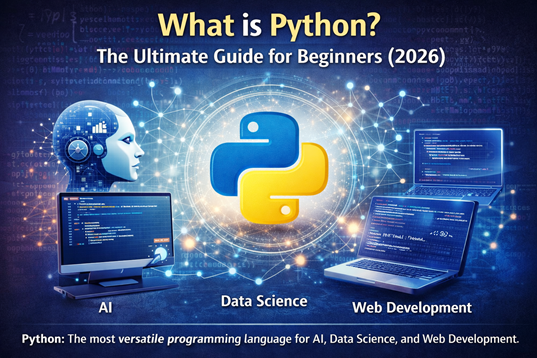
When you first step into the world of programming, one name you’ll hear over and over again is Python. Whether it’s web development, data analysis, artificial intelligence, automation, or scientific computing — Python seems to be everywhere.
But what exactly is Python? Why do developers, beginners, and companies all around the world love it so much?
In this post, we’ll break everything down — from Python’s definition to its best features, examples, and the reasons for its massive popularity.
An Introduction to Python Programming
Python is a high-level, general-purpose programming language that is dynamically typed and garbage-collected. It supports multiple programming paradigms, including procedural, object-oriented, and functional programming. Python is often described as a “batteries-included” language because it comes with a powerful and comprehensive standard library, allowing developers to build applications faster.
Python is an interpreted, open-source, object-oriented programming language with dynamic semantics. It supports modules and packages, which promote code modularity, reusability, and maintainability—making Python ideal for both small scripts and large-scale applications.
Python is widely used to build websites and web applications, automate repetitive tasks, and analyze and visualize data. As a general-purpose language, Python is not limited to a single domain. It is commonly used in web development, data science, machine learning, artificial intelligence, automation, and software development. Python is also a top choice for rapid application development due to its simplicity and extensive ecosystem.
One of Python’s core design goals is code readability. Its clean syntax and minimal boilerplate allow programmers to express complex ideas using fewer lines of code, making Python especially suitable for beginners learning programming.
Python is also known as a glue language because it can easily integrate with other programming languages and software components, helping developers combine different technologies into a single system.
A Simple Python Example
print('Hello, I am learning Python.')Hello, I am learning Python.This single line of Python code prints “Hello, I am learning Python” to the screen. There are no semicolons, no complex syntax, and no unnecessary code—just clean, readable Python. This simplicity is one of the main reasons Python is considered one of the best programming languages for beginners.
Note: For accurate and up-to-date information, beginners should regularly visit the official Python website. It is the most reliable source for Python releases, new features, and long-term support updates.
Key Features of Python
Python is one of the most popular programming languages in the world because of its powerful features, simplicity, and versatility. These features make Python an excellent choice for beginners, as well as for professional developers working on real-world applications.
1. Simple and Easy-to-Read Syntax
Python’s syntax is designed to be clear and readable, which helps beginners focus on learning programming concepts rather than struggling with complex syntax. Python code closely resembles the English language, reducing confusion and making it easier to understand and maintain.
2. Interpreted Language
Python is an interpreted language, meaning code is executed line by line at runtime. This makes debugging easier and speeds up development, as developers do not need to compile the program before running it.
3. High-Level Programming Language
Python is a high-level language, so developers do not need to manage low-level details such as memory allocation. This allows programmers to concentrate on solving problems and building applications efficiently.
4. Dynamically Typed
In Python, you do not need to declare variable data types explicitly. The language determines the data type at runtime, which makes coding faster and more flexible—especially helpful for beginners learning Python.
5. Object-Oriented and Multi-Paradigm
Python supports object-oriented programming, as well as procedural and functional programming styles. This flexibility allows developers to choose the best approach for their problem and write clean, reusable code.
6. “Batteries-Included” Standard Library
Python comes with a rich standard library that provides modules for file handling, mathematics, networking, web services, and more. This reduces the need for external libraries and helps developers build applications quickly.
7. Cross-Platform Compatibility
Python programs can run on multiple operating systems such as Windows, macOS, and Linux without significant changes. This makes Python a great choice for developing portable applications.
8. Large Community and Ecosystem
Python has a massive global community and an extensive ecosystem of third-party libraries and frameworks. This means beginners can easily find tutorials, documentation, and solutions to common problems.
9. Versatile and Scalable
Python is used in a wide range of fields, including web development, data science, machine learning, artificial intelligence, automation, and scientific computing. It can handle both small scripts and large-scale applications.
Why These Features Matter for Beginners
These key features reduce complexity, improve learning speed, and help beginners build real projects early in their programming journey. This is why Python is often recommended as the best programming language for beginners.
Applications of Python
Python is a versatile and powerful programming language used across many industries. Thanks to its simplicity, flexibility, and rich ecosystem, Python is suitable for both beginners and professional developers. Below are some of the most common and important applications of Python.
1. Web Development
Python is widely used to build dynamic websites and web applications. Popular Python web frameworks like Django and Flask help developers create secure, scalable, and maintainable web applications efficiently.
Examples:
- Blogs and content management systems
- E-commerce websites
- REST APIs and backend services
2. Data Science and Data Analysis
Python is one of the most preferred languages for data science and data analysis. Libraries such as NumPy, Pandas, and Matplotlib allow developers to process, analyze, and visualize large datasets easily.
Examples:
- Data cleaning and transformation
- Data visualization and reporting
- Exploratory data analysis
3. Machine Learning and Artificial Intelligence
Python plays a major role in machine learning and artificial intelligence (AI). Frameworks like TensorFlow, PyTorch, and Scikit-learn make it easier to build intelligent systems.
Examples:
- Recommendation systems
- Image and speech recognition
- Predictive analytics
4. Automation and Scripting
Python is commonly used for automation and scripting to save time and reduce manual effort. It can automate repetitive tasks such as file handling, data extraction, and system operations.
Examples:
- Automating file and folder tasks
- Web scraping
- Task scheduling
5. Software Development
Python is used to build desktop and standalone software applications. Its simplicity allows developers to focus on functionality rather than complex syntax.
Examples:
- GUI applications
- Command-line tools
- Cross-platform software
6. Game Development
Python can be used for game development, especially for beginners. Libraries like Pygame provide tools for creating simple 2D games and learning game logic.
Examples:
- 2D arcade games
- Educational games
- Game prototypes
7. Scientific and Numerical Computing
Python is widely used in scientific research and numerical computing. It supports complex mathematical calculations and simulations through libraries like SciPy.
Examples:
- Scientific simulations
- Engineering calculations
- Research-based computing
8. Cybersecurity and Ethical Hacking
Python is popular in cybersecurity and ethical hacking due to its ability to automate security tasks and analyze network data.
Examples:
- Network scanning tools
- Security testing scripts
- Vulnerability analysis
9. Finance and FinTech Applications
Python plays a major role in finance and FinTech applications due to its ability to handle large datasets, perform complex calculations, and automate workflows. It is widely used by financial institutions and startups.
Examples:
- Algorithmic trading systems
- Financial data analysis
- Risk management and forecasting
10. Desktop Application Development
Python is widely used for desktop application development. With libraries and frameworks such as Tkinter, PyQt, Kivy, and wxPython, developers can create cross-platform desktop applications with graphical user interfaces (GUIs).
Examples:
- Desktop utilities and tools
- GUI-based business applications
- Educational software
11. Internet of Things (IoT)
Python is also used in IoT applications, especially on devices like Raspberry Pi. It helps developers interact with hardware and sensors easily.
Examples:
- Home automation systems
- Sensor-based projects
- Smart devices
Why Python Is Used in So Many Applications
Python’s readability, extensive libraries, and strong community support make it suitable for almost every programming domain. This flexibility is a key reason why Python remains one of the most in-demand programming languages today.
History of Python
Python is a modern programming language with a rich history rooted in simplicity and readability. Understanding the history of Python helps beginners appreciate why Python is designed the way it is today.
Origin of Python
Python was created by Guido van Rossum, a Dutch programmer, in the late 1980s. Guido began working on Python at the Centrum Wiskunde & Informatica (CWI) in the Netherlands as a hobby project during the Christmas holidays. His goal was to design a programming language that was easy to read, easy to use, and powerful.
The name “Python” was inspired by the British comedy show Monty Python’s Flying Circus, not by the snake. This influence is still visible today in Python’s documentation and examples, which often use humor.
First Public Release
Python was officially released to the public in 1991. The early versions already included important features such as:
- High-level built-in data types
- Automatic memory management
- Support for modules and exception handling
These features made Python stand out from many other programming languages at that time.
Growth and Community Adoption
Throughout the 1990s and early 2000s, Python gained popularity due to its simple syntax and flexibility. Developers started using Python for scripting, automation, and application development. An open-source community formed around Python, contributing libraries, tools, and improvements.
This strong community support played a major role in Python’s long-term success.
Python 2 and Python 3
Python has had two major versions:
- Python 2, released in 2000, introduced features like list comprehensions and a full garbage collection system.
- Python 3, released in 2008, focused on fixing design limitations and improving consistency.
Python 3 introduced important changes such as:
- Better Unicode support
- Cleaner syntax
- Improved standard library design
Important Note: Python 2 reached its official end of life in January 2020. Today, Python 3 is the standard and recommended version for all new development.
Python Today
Today, Python is one of the most popular programming languages in the world. It is widely used in web development, data science, artificial intelligence, automation, finance, and education. Python’s ongoing development is managed by the Python Software Foundation (PSF), ensuring regular updates and long-term stability.
Python continues to evolve while staying true to its original philosophy: simple, readable, and powerful code.
Why Python’s History Matters
Understanding Python’s history helps beginners:
- Learn why Python emphasizes readability
- Understand the transition from Python 2 to Python 3
- Appreciate the role of community and open-source development
This background makes it easier to learn Python effectively and use it with confidence.
Advantages and Disadvantages of Python
Like any programming language, Python has its strengths and limitations. Understanding both helps beginners make informed decisions and avoid confusion when learning or choosing Python for real-world projects.
Advantages of Python
1. Easy to Learn and Use
Python has a simple, readable syntax that closely resembles the English language. This makes it one of the best programming languages for beginners, allowing them to focus on logic instead of complex syntax rules.
2. High Productivity
Python allows developers to write programs using fewer lines of code compared to many other languages. This speeds up development and makes Python ideal for rapid application development.
3. Large Standard Library and Ecosystem
Python comes with a “batteries-included” standard library and thousands of third-party libraries. This reduces development time because many common tasks are already supported.
4. Cross-Platform Compatibility
Python programs can run on Windows, macOS, and Linux with little or no modification, making it suitable for cross-platform development.
5. Strong Community Support
Python has a huge global community, which means:
- Extensive documentation
- Beginner-friendly tutorials
- Quick solutions to common problems
This community support greatly improves the learning experience.
6. Versatile and Widely Used
Python is used in web development, data science, AI, automation, finance, IoT, and education. Learning Python opens doors to multiple career paths.
Disadvantages of Python
1. Slower Execution Speed
Python is an interpreted language, which generally makes it slower than compiled languages like C or C++. This can be a limitation for performance-critical applications.
2. Not Ideal for Mobile App Development
Python is not commonly used for native mobile app development, especially compared to languages like Java, Kotlin, or Swift.
3. Higher Memory Consumption
Python programs typically consume more memory than programs written in low-level languages. This may not be suitable for memory-constrained environments.
4. Runtime Errors Due to Dynamic Typing
Because Python is dynamically typed, some errors are only detected at runtime. Beginners may face unexpected errors if they are not careful with data types.
5. Limited Use in Browser-Side Development
Python is mainly used on the server side. It is not a direct replacement for JavaScript in browser-based development.
Is Python Worth Learning?
Despite its limitations, Python’s advantages far outweigh its disadvantages—especially for beginners. Its simplicity, versatility, and strong community support make it an excellent first programming language and a powerful tool for real-world applications.
Examples of Python Programming
Learning Python becomes much easier when you see real examples. Below are some basic Python programming examples that demonstrate how Python works in everyday situations. These examples are commonly used by beginners to understand core concepts.
1. Hello World Program
This is the most basic Python program and is often the first step when learning any programming language.
print("Hello, World!")Hello, World!This example shows how Python prints text to the screen using the print() function.
2. Adding Two Numbers
This example demonstrates basic arithmetic operations in Python.
Marks1 = 458
Marks2 = 148
Total = Marks1 + Marks2
print("Sum of Marks:", Total)Sum of Marks: 606Python automatically understands the data type of variables, which makes calculations simple and readable.
3. Taking Input from the User
Python allows you to take input from the user using the input() function.
name = input("Enter your name: ")
print("Hello,", name)Enter your name: PyCoder
Hello, PyCoderThe input() function always returns a string, which is important for beginners to remember.
4. Conditional Statement (if–else)
Conditional statements are used to make decisions in Python.
marks = 500
if marks >= 400:
    print("Yes. You're qualified for next session.")
else:
print("Sorry. You're not qualified for next session.")Yes. You're qualified for next session.Python uses indentation instead of braces, which improves readability.
5. Using a for Loop
Loops are used to repeat tasks. This example prints numbers from 1 to 3.
for numbers in range (1, 4):
print(numbers)1
2
3The range() function generates a sequence of numbers.
6. Using a while Loop
A while loop runs as long as a condition remains true.
mark = 1

while mark <= 3:
    print(mark)
mark += 11
2
3while loops are useful when the number of iterations is not fixed.
7. Simple Function Example
Functions help organize code and improve reusability.
def information():
    print('Welcome to PyCoderHub!')

information()Welcome to Python programming!Functions allow you to reuse code without rewriting it.
Python vs Other Programming Languages
The table below compares Python with other popular programming languages to help beginners understand where Python stands and when to use it.
Comparison Table: Python vs Other Languages
| Feature | Python | Java | C++ | JavaScript |
|---|---|---|---|---|
| Language Type | High-level | High-level | Low-level / High-level | High-level |
| Syntax | Very simple, readable | Wordy | Complex | Moderate |
| Learning Curve | Very easy (best for beginners) | Moderate | Difficult | Moderate |
| Execution Speed | Moderate | Fast | Very fast | Fast |
| Typing System | Dynamic | Static | Static | Dynamic |
| Compilation | Interpreted | Compiled + JVM | Compiled | Interpreted |
| Memory Management | Automatic | Automatic | Manual | Automatic |
| Best Use Cases | Data science, AI, automation, web | Enterprise apps, Android | System software, games | Web development |
| Community Support | Very large | Very large | Large | Very large |
| Cross-Platform | Yes | Yes | Yes | Yes |
Quick Summary
- Python is best for beginners and rapid development
- Java is widely used for enterprise and large systems
- C++ is ideal for performance-critical applications
- JavaScript dominates web development
Python is easier to learn than Java, C++, and JavaScript, making it the most beginner-friendly programming language.
Conclusion
Python is one of the most beginner-friendly and versatile programming languages to learn in 2026. Its simple syntax, readable code, and wide range of applications make it an excellent choice for anyone starting their programming journey. From basic programs to advanced fields like web development, data science, automation, and artificial intelligence, Python continues to be a reliable and in-demand language.
What makes Python truly valuable is its ability to grow with the learner. Beginners can start with small programs and gradually move toward real-world projects, all while using the same language. With strong community support and continuous development, Python offers a solid foundation for building long-term programming skills.
Suggested Posts:
1. The Evolution and History of Python: From Hobby Project to Global Dominance (1989–2026)
2. Understanding Python Programming Terms: High-Level, Interpreted, Garbage-Collected Explained
3. How to Install Python and Set Up PyCharm (Beginner’s Guide)
4. Python IDLE Explained: Comparison with PyCharm, CMD, and Notepad
5. Python Introduction FAQs: Common Beginner Questions Answered

2 thoughts on “What is Python? The Ultimate Guide for Beginners (2026)”