Skip to content

PyCoderHub

Learn Python Step by Step — From Basics to Advanced

  • Home
  • Python Tutorial
    • Chapter 1: Python Introduction
      • Lesson 1: What is Python?
      • Lesson 2: Python History
      • Lesson 3: Python Programming Terms Explained
      • Lesson 4: Installation of Python and PyCharm IDE
      • Lesson 5: Python IDLE Explained
      • Lesson 6: Python Introduction FAQs
    • Chapter 2: Python Variables
      • Lesson 1: Python Variables Explained
      • Lesson 2: Assigning Multiple Values to Python Variables
      • Lesson 3: Variable Unpacking in Python
      • Lesson 4: Python Variable Naming Rules and Conventions
      • Lesson 5: Dynamic Typing in Python
      • Lesson 6: Strong Typing in Python
      • Lesson 7: Python Variables FAQs
    • Chapter 3: Python Comments
      • Lesson 1: Python Comments Explained
      • Lesson 2: Python Single-Line and Multi-Line Comments Explained
      • Lesson 3: PEP 8 Guidelines for Python Comments
      • Lesson 4: Python Comments FAQ
    • Chapter 4: Python Docstrings
      • Lesson 1: Python Docstrings Explained
      • Lesson 2: Python Docstring Structure and Style Guide
      • Lesson 3: PEP 257 Guidelines for Python Docstrings
      • Lesson 4: Python Docstrings FAQ
    • Chapter 5: Python Quotes
      • Lesson 1: Python Quotes Explained
      • Lesson 2: Python Quotes Rules and Guidelines
      • Lesson 3: Python Quotes Best Practices
      • Lesson 4: Quotes vs Comments vs Docstrings in Python
      • Lesson 5: Python Quotes FAQ
    • Chapter 6: Python Indentation
      • Lesson 1: Python Indentation Explained
      • Lesson 2: Python Indentation Rules and Guidelines
      • Lesson 3: Python Nested Indentation & Block of Code
      • Lesson 4: Python Indentation Common Errors
      • Lesson 5: Python Indentation Best Practices
      • Lesson 6: Python Indentation FAQ
    • Chapter 7: Python Escape Sequences
      • Lesson 1: Python Escape Sequences Explained
      • Lesson 2: Common Python Escape Sequences \n \t \ Explained
      • Lesson 3: Less Common Python Escape Sequences \f \b \r Explained
      • Lesson 4: Python Escape Sequences Rules
      • Lesson 5: Python Escape Sequences Errors
      • Lesson 6: Python Escape Sequences Best Practices
      • Lesson 7: Python Escape Sequences FAQ
    • Chapter 8: Python Keywords
      • Lesson 1: Python Keywords Explained
      • Lesson 2: Python Control Flow, Function and Class Keywords Explained
  • Contact Us
Start Your Python Journey

Home » Python Variables Multiple Assignment

Python Variables Multiple Assignment

Assigning Multiple Values to Python Variables: A Complete Guide with Examples
Posted in
  • Python Basics

Assigning Multiple Values to Python Variables: A Complete Guide with Examples

Assigning Multiple Values to Python Variables can be simple and powerful. This guide explains everything from unpacking collections to swapping variables, with practical examples for beginners and advanced users.
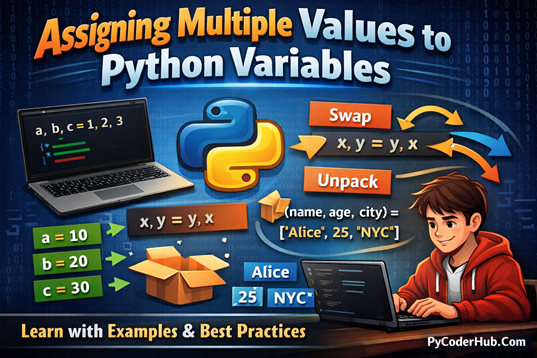
Assigning Multiple Values to Python Variables: A Complete Guide with Examples Read More
by PyCoder-January 13, 2026January 21, 2026

Archives

  • March 2026 (13)
  • February 2026 (17)
  • January 2026 (19)

Categories

  • Python Basics (25)
  • Python Best Practices (4)
  • Python Errors and Fixes (3)
  • Python FAQs (7)
  • Python Modules (1)
  • Python PEP Guidelines (7)
  • Python Practicals (2)
Copyright © 2026 PyCoderHub.
Powered by WordPress and HybridMag.
  • Home
  • Python Tutorial
    • Chapter 1: Python Introduction
      • Lesson 1: What is Python?
      • Lesson 2: Python History
      • Lesson 3: Python Programming Terms Explained
      • Lesson 4: Installation of Python and PyCharm IDE
      • Lesson 5: Python IDLE Explained
      • Lesson 6: Python Introduction FAQs
    • Chapter 2: Python Variables
      • Lesson 1: Python Variables Explained
      • Lesson 2: Assigning Multiple Values to Python Variables
      • Lesson 3: Variable Unpacking in Python
      • Lesson 4: Python Variable Naming Rules and Conventions
      • Lesson 5: Dynamic Typing in Python
      • Lesson 6: Strong Typing in Python
      • Lesson 7: Python Variables FAQs
    • Chapter 3: Python Comments
      • Lesson 1: Python Comments Explained
      • Lesson 2: Python Single-Line and Multi-Line Comments Explained
      • Lesson 3: PEP 8 Guidelines for Python Comments
      • Lesson 4: Python Comments FAQ
    • Chapter 4: Python Docstrings
      • Lesson 1: Python Docstrings Explained
      • Lesson 2: Python Docstring Structure and Style Guide
      • Lesson 3: PEP 257 Guidelines for Python Docstrings
      • Lesson 4: Python Docstrings FAQ
    • Chapter 5: Python Quotes
      • Lesson 1: Python Quotes Explained
      • Lesson 2: Python Quotes Rules and Guidelines
      • Lesson 3: Python Quotes Best Practices
      • Lesson 4: Quotes vs Comments vs Docstrings in Python
      • Lesson 5: Python Quotes FAQ
    • Chapter 6: Python Indentation
      • Lesson 1: Python Indentation Explained
      • Lesson 2: Python Indentation Rules and Guidelines
      • Lesson 3: Python Nested Indentation & Block of Code
      • Lesson 4: Python Indentation Common Errors
      • Lesson 5: Python Indentation Best Practices
      • Lesson 6: Python Indentation FAQ
    • Chapter 7: Python Escape Sequences
      • Lesson 1: Python Escape Sequences Explained
      • Lesson 2: Common Python Escape Sequences \n \t \ Explained
      • Lesson 3: Less Common Python Escape Sequences \f \b \r Explained
      • Lesson 4: Python Escape Sequences Rules
      • Lesson 5: Python Escape Sequences Errors
      • Lesson 6: Python Escape Sequences Best Practices
      • Lesson 7: Python Escape Sequences FAQ
    • Chapter 8: Python Keywords
      • Lesson 1: Python Keywords Explained
      • Lesson 2: Python Control Flow, Function and Class Keywords Explained
  • Contact Us