
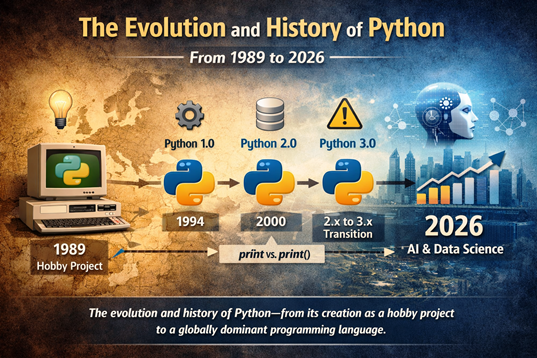
Introduction: The Python Phenomenon
As of 2026, Python stands among the most influential programming languages in history—fueling breakthroughs from artificial intelligence and scientific discovery to backend web systems and serving as the first programming language for millions of learners around the world.
Consider these recent trends:
- Python consistently ranks at the top of major language popularity indexes, with one of the highest rating scores ever recorded in the Tiobe Index, far ahead of legacy competitors.
- According to the 2025 Stack Overflow Developer Survey, Python’s adoption reached roughly 58% of professional developers, marking one of the largest yearly growth jumps in modern times.
- On Stack Overflow and other community platforms, Python-related questions and discussions remain among the most active topics, reflecting its massive global usage.
Yet this dominance wasn’t predetermined. It emerged from a series of clear design decisions, cultural shifts, and well-timed technological momentum—all tracing back to one person’s Christmas hobby project.
In This Post, You’ll Learn How Python:
- Started as a small hobby project in 1989
- Grew step by step through community-driven development
- Became easy enough for beginners yet powerful for professionals
- Expanded into web development, data science, AI, and automation
- Turned into one of the most widely used programming languages in the world by 2026
The Birth of Python
Every programming language has a starting point. Python’s journey began in the late 1980s with a simple goal: to create a programming language that was easy to read, easy to write, and practical for real-world use.
The Origin of Python
Python was created at a time when many programming languages were powerful but difficult for beginners to learn. Its origin is closely tied to its creator, workplace, and the need for a simpler, more readable alternative.
- Creator: Guido van Rossum
- Year: 1989
- Place: CWI (Centrum Wiskunde & Informatica), Netherlands
- Inspired By: ABC language, a teaching language developed at CWI with a strong focus on readability and simplicity
- Why the Name “Python”?: Named after the British comedy group Monty Python, not the snake
Python’s story begins in the late 1980s in the Netherlands. Guido van Rossum, a researcher at the Centrum Wiskunde & Informatica (CWI), was working on the ABC language and needed a hobby project to keep him busy during the Christmas break of 1989. He wanted to build a language that was:
- Easy to read and write
- Powerful enough for system tasks
- A balance between C and shell scripting
“I wanted to create an interpreted language that would be easy to use, but also appeal to programmers familiar with Unix and C.” — Guido van Rossum
These early choices shaped Python’s core philosophy and laid the foundation for its steady growth in the years that followed.
The Name: Why It’s Called Python
Contrary to popular belief, Python is not named after the snake. Guido van Rossum chose the name because he was a fan of the British comedy show Monty Python’s Flying Circus. He wanted the language name to be short, unique, and a little fun, reflecting Python’s friendly and approachable nature.
This influence is why Python’s official documentation and tutorials often include playful references like “spam,” “eggs,” and other Monty Python jokes. These references also highlight an important part of Python’s culture: programming doesn’t have to be serious or difficult to be powerful.
Python’s First Release (Python 0.9.0)
The first official version, Python 0.9.0, was released in February 1991. Even at this early stage, Python included several features that made it stand out from other languages of the time:
- Exception handling for better error management
- Functions to organize and reuse code
- Core built-in data types such as
list,dict, andstr
However, some features were still missing. For example, automatic garbage collection was not included in Python 0.9.0—it was introduced later with Python 1.0, as the language continued to mature.
These early design choices set the tone for Python’s future: simple syntax, powerful features, and a strong focus on developer experience.
The Languages That Inspired Python
Before creating Python, Guido van Rossum worked on the ABC programming language, a teaching language developed at CWI. ABC strongly influenced Python’s focus on readability, simplicity, and ease of learning. However, ABC also had limitations, which motivated Guido to combine its best ideas with features from other languages and systems.
Below is a quick overview of the main languages and technologies that shaped Python’s design:
| Language / System | Contribution to Python |
|---|---|
| ABC | Clear, readable syntax and high-level data structures |
| C | Performance, low-level control, and easy extensibility |
| Modula-3 | Strong support for modular programming and exception handling |
| Unix Shell | Interactive usage and powerful scripting capabilities |
By blending ideas from these sources, Python achieved a unique balance: simple enough for beginners, yet flexible and powerful enough for experienced developers.
Example: Simplicity Inspired by ABC
One of ABC’s biggest influences on Python is how naturally code can be read and understood. Even someone new to programming can often guess what the code does:
# Python code inspired by ABC-style simplicity
numbers = [1, 2, 3, 4]
squares = [a**2 for a in numbers]
print(squares)[1, 4, 9, 16]This example shows how Python allows you to express complex ideas with very little code, staying close to natural language—an idea that has guided Python’s evolution since the very beginning.
The Zen of Python: Guiding Principles
As Python evolved, its philosophy became just as important as its features. This philosophy is best captured in “The Zen of Python”, a short collection of guiding principles written by Tim Peters, one of Python’s early contributors.
The Zen of Python explains how Python code should be written and how Python developers should think. Instead of strict rules, it offers simple ideas that encourage clarity, consistency, and readability.
Some of the most important principles include:
- Simple is better than complex
- Readability counts
- There should be one—and preferably only one—obvious way to do it
- Errors should never pass silently
- If the implementation is hard to explain, it’s a bad idea
These principles influenced many of Python’s design decisions, from clean syntax and meaningful indentation to straightforward error handling. They also help beginners write better code early on, while guiding experienced developers toward clear and maintainable solutions.
You can view the Zen of Python directly in Python by running:
import thisEven decades after Python’s creation, the Zen of Python remains a core reason why Python code feels clean, approachable, and easy to understand—and why the language continues to attract developers worldwide.
The Early Years: Python 0.x (1991–1994)
The Python 0.x era marks the very beginning of the language. During this phase, Python was still experimental, but it introduced the core syntax, readability, and design philosophy that would shape all future versions.
Python 0.9.0 (February 1991)
Python’s first public release, Python 0.9.0, arrived in February 1991 and already included many features that still define the language today.
Key features introduced in Python 0.9.0:
- Core data types such as
str,list, anddict - Built-in exception handling
- Support for functions and modules
- Basic input/output operations and flow control
Example: Simple Function in Early Python
def greet(name):
    print("Hello", name)

greet("World")
Even in this early version, Python’s syntax was clean, readable, and indentation-based, making the code easy to understand—very similar to how Python looks and feels today.
The 1.x Era (1994–2000): Foundation and Growth
The Python 1.x era transformed Python from an experiment into a stable and usable programming language. This period focused on strengthening core features, expanding the standard library, and building the foundation for Python’s long-term growth.
Python 1.0 (January 1994)
Python 1.0 marked the language’s first stable release, turning Python from an experimental project into a reliable programming language for real-world use.
Major additions in Python 1.0:
- Functional programming tools such as
lambda,map(),filter(), andreduce() - Improved exception handling
- Stronger support for modular programming
Example: Using lambda and map()
numbers = [1, 2, 3, 4]
squares = list(map(lambda x: x ** 2, numbers))
print(squares)
These features made Python more expressive while keeping the code concise and readable.
Python 1.4 (1996)
Python 1.4 focused on making the language more flexible and powerful, especially for scientific and advanced programming tasks.
Key improvements in Python 1.4:
- Introduction of keyword arguments (for example,
func(name='Alice')) to make function calls clearer - Built-in support for complex numbers (such as
3 + 4j), improving mathematical capabilities - Addition of the
picklemodule for object serialization and data persistence - Further improvements to exception handling for better error control
These updates helped Python gain popularity in academic and research environments.
Python 1.5 (1997)
With Python 1.5, the language became more structured and scalable, setting the stage for broader adoption.
Notable changes in Python 1.5:
- Introduction of DOM (Document Object Model) support
- A more robust module and package system
- Rapid expansion of the standard library
This version laid the groundwork for Python’s growing ecosystem and long-term success.
The 2.x Era (2000–2010): The Transitional Decade
The Python 2.x era was a turning point in Python’s history. During this decade, Python gained many features that still define the language today, while also preparing developers for the major changes introduced in Python 3. This period is often called transitional because it balanced backward compatibility with long-term evolution.
Python 2.0 (October 2000)
Python 2.0 introduced several powerful features that shaped modern Python programming and expanded its use in real-world applications.
Key features in Python 2.0:
- List comprehensions, inspired by functional programming
- Automatic garbage collection for better memory management
- Early Unicode support to handle international text
- Iterators, enabling more efficient looping over data
Example: List Comprehensions
squares = [x ** 2 for x in range(10)]
print(squares)
This feature made Python code shorter, clearer, and easier to read.
Python 2.2 (December 2001)
Python 2.2 introduced one of the most important internal changes in Python’s history by improving the object model.
Major improvements in Python 2.2:
- Introduction of new-style classes, where all classes inherit from
object - Addition of generators using the
yieldkeyword for memory-efficient iteration - New built-in functions like
zip()andenumerate() - Support for
__slots__to control attribute creation and reduce memory usage - Better unification of built-in types and user-defined classes
These changes made Python more consistent and powerful, especially for large applications.
Python 2.5 (September 2006)
Python 2.5 focused on writing cleaner, safer, and more readable code.
Key features introduced in Python 2.5:
- The
withstatement for proper resource management
(e.g.,with open('file.txt') as f:) - Unified
try / except / finallysyntax - The
@contextmanagerdecorator in thecontextlibmodule - Introduction of
any()andall()built-in functions
These improvements helped reduce common programming errors and improved code clarity.
Python 2.7 (July 2010)
Python 2.7 was the final major release of the Python 2.x series. It served as a bridge between Python 2 and Python 3 by backporting several modern features.
Notable backported features in Python 2.7:
- Dictionary comprehensions
- Improved
withstatement support - Partial compatibility with the
print()function syntax
Example: Dictionary Comprehensions
squares = {x: x**2 for x in range(5)}
print(squares)
Official support for Python 2 ended on January 1, 2020, marking the end of an era and encouraging the global Python community to fully transition to Python 3.
The 3.x Era (2008–Present): The Modern Python
The Python 3.x era represents a bold reset in Python’s evolution. Instead of continuing backward compatibility at all costs, Python 3 focused on fixing long-standing design issues, simplifying the language, and preparing it for the future. This era transformed Python into the modern, high-performance, and scalable language we use today.
Python 3.0 (December 2008)
Also known as “Python 3000” or “Py3k”, Python 3.0 was a backward-incompatible release. It was not a routine upgrade but a new beginning, designed to clean up inconsistencies that had accumulated in Python 2.
Major changes in Python 3.0:
printbecame a function →print("Hello")- Unicode by default, improving international text handling
- Removal of outdated syntax such as
<> - Integer division now returns a float (
5 / 2 = 2.5) - Clear separation between
bytesandstr
Example: Simple Python 3 Output
print("Python 3 says hello!")These changes laid the foundation for all future Python releases.
Python 3.3 (September 2012)
Python 3.3 focused on improving development workflows and debugging.
Key features:
- Introduction of the
venvmodule for lightweight virtual environments yield fromsyntax for cleaner generator delegation- Addition of the
__qualname__attribute for better introspection - Improved filesystem encoding for cross-platform compatibility
- New
faulthandlermodule for debugging crashes
Python 3.5 (September 2015)
Python 3.5 marked a major leap forward with native support for asynchronous programming.
Highlights:
- Introduction of
asyncandawaitkeywords - New
@operator for matrix multiplication (used heavily in NumPy) - Type hints via the
typingmodule - Generalized unpacking (
{**dict_one, **dict_two}) - Introduction of
pathlibfor modern filesystem handling
Python 3.6 (December 2016)
Python 3.6 significantly improved code readability and performance.
Notable additions:
- f-strings for fast and readable string formatting
- Underscores in numeric literals (e.g.,
1_000_000) - Asynchronous comprehensions and async generators
- New dictionary implementation (insertion-ordered)
secretsmodule for cryptographically secure random values
Python 3.8 (October 2019)
Python 3.8 introduced features that made code more expressive and debuggable.
Key updates:
- The walrus operator (
:=) for assignment expressions - Positional-only parameters using
/ - Debug-friendly f-strings (
f"{variable_value=}") - New math and statistics utilities
- Improved tracebacks and interpreter optimizations
Python 3.9 (October 2020)
Python 3.9 refined syntax, typing, and performance.
Major features:
- Dictionary merge and update operators (
|,|=) - Simplified type hints (
list[int]) - New string methods:
removeprefix()andremovesuffix() - Time zone support via
zoneinfo - Introduction of the PEG parser, replacing the legacy parser
Python 3.10 (October 2021)
Python 3.10 focused on readability and developer experience.
Highlights:
- Structural pattern matching (
match / case) - Cleaner multi-line
withstatements - More precise and helpful error messages
- Union types using
|(e.g.,int | str) - Continued performance improvements
Python 3.11 (October 2022)
Python 3.11 delivered one of the largest performance boosts in Python’s history.
Key improvements:
- Execution speed improvements of 10–60%
ExceptionGroupandexcept*for concurrent exception handling- Richer, more accurate tracebacks
- Enhanced typing features such as
SelfandLiteralString
Python 3.12 (October 2023)
Python 3.12 continued Python’s modernization efforts.
Notable changes:
- Further speed and memory optimizations
- Refined typing features like
TypeVarTuple - Improved f-string flexibility
- Removal of deprecated modules for a cleaner standard library
Python 3.13 (October 2024)
Python 3.13 introduced groundbreaking concurrency experiments.
Major updates:
- Experimental free-threaded CPython (no GIL)
- Improved interactive REPL with syntax highlighting
- Stronger typing and stricter checks
- Faster startup times and reduced memory usage
- Continued standard library cleanup
Python 3.14 (October 2025)
Python 3.14 pushed Python closer to true parallelism and better tooling.
Key features:
- Official support for free-threaded builds
- Deferred evaluation of annotations
- Introduction of template string literals (t-strings)
- Better support for sub-interpreters
- Enhanced REPL and developer tooling
Python Today and Beyond: Python 3.14 and the Road Ahead (2026+)
After exploring Python’s journey from a small hobby project to global dominance, it’s time to look at where Python stands today—and where it’s headed next.
As of 2026, the current stable version of Python is Python 3.14, as officially released by the Python Software Foundation. This release represents the most mature and forward-looking version of Python so far, continuing the language’s long-term focus on performance, concurrency, developer experience, and modern tooling.
What’s New in Python 3.14
Python 3.14 builds upon the performance and cleanup efforts of earlier 3.x releases while introducing features designed for the future:
- Official support for free-threaded Python, allowing Python to run without the Global Interpreter Lock (GIL) in supported configurations
- Deferred evaluation of type annotations, improving performance and making forward references easier to manage
- Introduction of template string literals (t-strings) for more flexible and customizable string templating
- Improved support for multiple interpreters (sub-interpreters) in the standard library
- Enhanced REPL experience, including better syntax highlighting, clearer error messages, and improved tooling
- Continued standard library cleanup, removing legacy modules and improving consistency
These changes make Python faster, more scalable, and better suited for modern workloads such as AI, data science, high-concurrency systems, and cloud-native applications.
Looking Ahead: Python 3.15 and Beyond (Expected in 2026)
The next major release, Python 3.15, is expected to arrive in 2026 and will continue Python’s evolution rather than disrupt it.
While exact features may evolve during development, Python 3.15 is expected to focus on:
- Further improvements to free-threaded Python and parallel execution
- Additional performance optimizations across the interpreter
- Continued enhancements to the typing system
- Better tooling and developer experience
- Ongoing removal of deprecated behavior to keep the language clean and maintainable
Instead of radical breaking changes, Python’s future emphasizes steady refinement, ensuring the language remains both beginner-friendly and powerful for large-scale systems.
Python’s Future Beyond 2026
Python’s success has always come from its ability to evolve without losing its core identity. As Python moves beyond 2026, it is expected to remain:
- A first-choice language for beginners
- A dominant force in AI, data science, and automation
- A reliable platform for large-scale and high-performance systems
- A language driven by a strong global community
From a Christmas hobby project in 1989 to a cornerstone of modern computing, Python’s story is still being written—and its future looks stronger than ever.
Features Added and Removed Over Time
Over the years, Python has continuously evolved by adding powerful features, removing outdated ideas, and refining its design. Below is a clear, era-by-era overview of how Python’s features changed and why those changes mattered.
Python 1.x Series (1994–2000)
The Python 1.x series focused on building a strong and reliable foundation for the language.
Added features:
- Keyword arguments for clearer function calls
- Built-in support for complex numbers
- Introduction of the
picklemodule for object serialization (Python 1.4)
Primary goal:
To establish the core language, introduce basic object-oriented programming, and support mathematical and scientific use cases.
Python 2.x Series (2000–2010)
The Python 2.x series expanded Python’s capabilities while remaining mostly backward-compatible.
Key additions by version:
- Python 2.0 (2000): List comprehensions, garbage collection, early Unicode support
- Python 2.2 (2001): New-style classes, iterators, generators, descriptors
- Python 2.5 (2006):
withstatement,ctypes,any()andall()functions
Removed features:
- Very few removals; Python 2.x prioritized backward compatibility
Primary goal:
To improve object-oriented programming, enhance readability, and prepare the groundwork for Python 3.
Python 3.0 (2008): The Big Break
Python 3.0 was a backward-incompatible release designed to clean up long-standing issues.
Added features:
- Unicode by default
print()as a function- Clearer integer division behavior
- Strict separation between
bytesandstr
Removed features:
- Outdated syntax such as
<> - Old-style classes
- Implicit string and byte conversions
Primary goal:
A complete language cleanup and modernization, even at the cost of breaking compatibility.
Python 3.3–3.6 (2012–2016)
This phase focused on modern syntax, performance, and asynchronous programming.
Major additions:
- Python 3.3:
venv,yield from, improved filesystem encoding - Python 3.5:
async/await, type hints,@matrix multiplication operator - Python 3.6: f-strings, numeric literal underscores, async generators
Primary goal:
Better readability, modern syntax, and first-class support for asynchronous programming.
Python 3.10–3.12 (2021–2023)
This period marked major improvements in performance, typing, and clarity.
Highlights:
- Python 3.10: Structural pattern matching (
match / case), union types using| - Python 3.11: Major speed improvements,
ExceptionGroup, richer tracebacks - Python 3.12: Faster startup, improved f-strings, refined typing system
Removed features:
- Deprecated standard library modules and outdated APIs
Primary goal:
High performance, clearer error messages, and a mature typing system.
Python 3.13 (2024)
Python 3.13 introduced experimental changes aimed at improving concurrency.
Added features:
- Experimental free-threaded CPython (without the GIL)
- Improved interactive REPL
- Further typing enhancements
Primary goal:
Enable true multithreading and improve the developer experience.
Python 3.14 (2025)
Python 3.14 builds directly on Python 3.13’s direction.
Added features:
- Official support for free-threaded builds
- Template string literals (t-strings)
- Deferred evaluation of type annotations
- Improved multi-interpreter support
Primary goal:
Safer string templating, modern concurrency, and deeper runtime control.
Python 2 vs Python 3: What Changed and Why It Matters
Python 2 and Python 3 are not just different versions — they represent two different design philosophies.
Python 2 focused on backward compatibility and rapid adoption, while Python 3 was a deliberate redesign aimed at fixing long-standing confusion, improving consistency, and making Python future-ready.
Understanding these differences helps explain why Python 3 exists, why Python 2 was officially retired, and why modern Python development exclusively targets Python 3.
Python 2 vs Python 3 — Feature Comparison Table
| Feature | Python 2 | Python 3 |
|---|---|---|
| Print syntax | Statement (print "text") | Function (print("text")) |
| Integer division | 5 / 2 = 2 | 5 / 2 = 2.5 |
| Unicode handling | ASCII by default | Unicode by default |
| String vs bytes | Mixed and confusing | Clearly separated |
| Range behavior | range() returns list | range() returns iterable |
| Input handling | raw_input() | input() |
| Error handling | Less consistent | Cleaner, more descriptive |
| Development status | Ended in 2020 | Actively developed |
Key Differences Explained with Examples
1. Print Statement vs Print Function
Python 2
print "Welcome to PyCoder Hub."Python 3
print("Welcome to PyCoder Hub.")In Python 3, print() behaves like a regular function, allowing keyword arguments such as sep, end, and file, making output handling more flexible and consistent.
2. Integer Division Behavior
Python 2
print "Division result:", 5 / 2Output:
2Python 3
print ("Division result:", 5 / 2)Output:
Division result: 2.5- Python 3 follows mathematically correct division by default.
- Python 2’s behavior often caused confusion for beginners.
3. Explicit Floor Division (Same in Both)
If you want integer division intentionally:
print("Floor division result:", 5 // 2)Output:
Floor division result: 24. Unicode and Text Handling
Python 2 (confusing by default)
user_message = "Hello"This is ASCII, not Unicode.
Python 3 (clean and predictable)
user_message = "Hello"This is Unicode by default.
5. Input Handling
Python 2
user_name = raw_input("Enter your name: ")Python 3
user_name = input("Enter your name: ")Python 3 removes ambiguity by making input() always return a string.
6. Range Behavior (Memory Efficiency)
Python 2
number_series = range(10)Output: Creates a full list in memory.
Python 3
number_series = range(10)Output: Creates a lazy iterable, improving performance and memory usage.
Conclusion
Python’s journey from a small hobby project in 1989 to a globally dominant programming language is a result of smart design choices, strong community support, and a constant focus on readability and simplicity. Each phase of Python’s evolution—early releases, the 2.x transition period, and the modern 3.x era—played a key role in shaping the language we use today.
With Python 3.14 and future versions continuing to improve performance, concurrency, and developer experience, Python remains highly relevant in 2026 and beyond. Its ability to adapt while staying beginner-friendly ensures that Python will continue to power innovation—and introduce millions of new programmers to coding—for years to come.
Suggested Posts:
1. What is Python? The Ultimate Guide for Beginners (2026)
2. Understanding Python Programming Terms: High-Level, Interpreted, Garbage-Collected Explained
3. How to Install Python and Set Up PyCharm (Beginner’s Guide)
4. Python IDLE Explained: Comparison with PyCharm, CMD, and Notepad
5. Python Introduction FAQs: Common Beginner Questions Answered

hey there and thank you for your information – I’ve
certainly picked up something new from right here.
I did however expertise a few technical issues using this site, as I experienced to reload the
website lots of times previous to I could get it to load
correctly. I had been wondering if your web host is OK?
Not that I am complaining, but sluggish loading instances
times will often affect your placement in google and can damage your high quality score if advertising and marketing with Adwords.
Anyway I’m adding this RSS to my e-mail and can look out for much more of your respective interesting content.
Ensure that you update this again soon.